Return Policy Template for EU Online Stores (Plain Language)
Return policy template for EU online stores: the 14-day withdrawal rules, a fill-in policy in plain language, common mistakes and where to publish it.

A good return policy template for an EU online store does three things. It states the legal 14-day right of withdrawal, it separates “I changed my mind” from “the product is faulty,” and it gives every deadline as a number. Customers read it before they buy, and your support team and chat assistant answer from it after they buy.
Returns are a buying decision, not an afterthought. In Baymard Institute’s checkout research (updated 2025), 13% of US online shoppers who abandoned a checkout did so because the return policy wasn’t satisfactory. A 2025 survey by the National Retail Federation and Happy Returns found that 71% of US consumers are less likely to shop again with a retailer after a poor returns experience.
This guide covers the EU rules from the source texts, a fill-in policy you can copy, and the writing rules that keep answers consistent. For the wider picture of automated store support, see our complete guide to ecommerce chatbots.
Not legal advice. The rules below come from EU directives. Each country transposes them into national law, sometimes with extra requirements. Check your national rules, or ask a lawyer, before you publish.
Key Takeaways
- EU shoppers have 14 days to withdraw from an online purchase without giving a reason. The period expires 14 days after the day they (or a person they name, other than the carrier) acquire physical possession of the goods (Directive 2011/83/EU, Art. 9).
- You must refund within 14 days of the withdrawal, including standard delivery, using the original payment method.
- “Changed my mind” (14 days) and “faulty” (minimum 2-year legal guarantee) are separate rules and belong in separate sections.
- Write one rule per sentence, with concrete numbers and no “may,” so customers and AI assistants read it the same way.
- Publish the policy in the footer, at checkout, near the buy button, in the order confirmation email and in your chat knowledge base.
What the EU 14-day return rule actually says
The core rule is simple: a consumer who buys online can withdraw from the contract within 14 days without giving a reason. That comes from Article 9 of the Consumer Rights Directive 2011/83/EU. The details below decide whether your policy is correct.
Shoppers and many policies say “cancel,” while the directive says “withdraw.” Both mean the same legal right of withdrawal, and this guide uses “withdraw” for the 14-day right from here on.
When the 14 days start
For goods, the clock starts when the customer, or a third person they name, takes physical possession of the product. The courier doesn’t count. If one order arrives in several parcels, the 14 days start when the last item arrives.
The EU’s Your Europe returns page adds a practical detail. If the last day falls on a non-working day, the deadline moves to the next working day.
How the customer withdraws
Customers can use the EU model withdrawal form or any clear statement, such as an email that says “I want to cancel order 1042.” Sending the message before the deadline is enough. If you offer an online withdrawal form, you must confirm receipt on a durable medium, such as an email.
The directive includes model withdrawal instructions (Annex I(A)) and a model withdrawal form (Annex I(B)). Under Article 6(4), a trader who fills in the model instructions correctly meets the information requirement on the right of withdrawal. Both annexes are in the consolidated text of the directive, and sections 1 to 4 of the template below should match the model instructions.
Sending back and refunding
After withdrawing, the customer has another 14 days to send the goods back (Article 14). The customer pays the direct cost of the return only if you told them so before they bought. If you didn’t, you pay.
You refund all payments, including standard delivery, within 14 days of being told about the withdrawal (Article 13). Use the same payment method unless the customer agrees to something else, and charge no fees. Two limits help you:
- If the customer chose a more expensive delivery option, you refund only the cost of standard delivery.
- You can hold the refund until you receive the goods back or the customer shows proof of sending, whichever comes first.
Customers can handle the product as they would in a shop. They are liable only for loss of value caused by handling beyond what’s needed to check what it is and how it works.

Products you can exclude
Article 16 lists the exceptions. The ones that matter most to online stores are:
- Goods made to the customer’s specifications or clearly personalized.
- Goods that deteriorate or expire quickly.
- “Sealed goods which are not suitable for return due to health protection or hygiene reasons and were unsealed after delivery” (Art. 16(e)).
- Goods inseparably mixed with other items after delivery.
- Sealed audio, video or software, once unsealed.
- Newspapers and magazines, except subscriptions.
- Digital content not supplied on a tangible medium, once performance has begun. Where the contract places the consumer under an obligation to pay, this applies only if the customer gave prior express consent, acknowledged that they thereby lose the right of withdrawal, and you confirmed this on a durable medium, such as an email (Art. 16(m), as amended by Directive (EU) 2019/2161).
The hygiene exception is narrow: it covers only sealed goods of that kind, unsealed after delivery, so don’t use it as a general “opened items” rule. Check your national guidance before you rely on it for a product. Sale items, opened boxes and “final clearance” products are not on this list.
What happens if you never mention the right of withdrawal
Silence costs you time and money. Under Article 10, if you don’t inform the customer about the right of withdrawal, the 14-day period is extended by 12 months. If you inform them during those 12 months, the period ends 14 days after they receive the information.
There is a second cost. Under Article 14(2), a consumer who was not informed about the right of withdrawal is not liable for any loss of value in the goods.
This is not a rare gap. A sweep published in 2025 by the European Commission checked 356 second-hand online traders and found that 40% didn’t clearly inform consumers of their withdrawal right.
The new online withdrawal function
Directive (EU) 2023/2673 (CELEX 32023L2673) adds Article 11a to the Consumer Rights Directive. It requires an online withdrawal function for contracts concluded through an online interface, and it applies from 19 June 2026. In practice, this points to a clearly labeled way to withdraw directly on your site. Verify the exact scope, wording and placement rules with your national transposition before you change your checkout.
Changing your mind vs. a faulty product: two different rules
Most confusing return policies mix these two situations. They come from different laws, run on different clocks and have different cost rules.
| Changed my mind | Faulty or not as described | |
|---|---|---|
| Legal basis | Directive 2011/83/EU (right of withdrawal) | Directive (EU) 2019/771 (legal guarantee) |
| Time limit | 14 days from delivery, then 14 days to send back | At least 2 years from delivery |
| Reason needed | No | Yes, a defect or mismatch |
| Remedy | Full refund | Customer chooses repair or replacement; if neither is possible, or the problem is serious or not fixed in reasonable time, a price reduction or, unless the fault is minor, a refund |
| Return shipping | Customer pays only if told in advance | Seller pays |
| Burden of proof | Not relevant | Defects appearing within 1 year are presumed present at delivery (2 years in some countries) |
The EU’s guarantees page also confirms that a commercial warranty from you or the manufacturer can’t reduce these legal rights. It can only add to them.
How to write your return policy in five steps
You’ll need about an hour, your current terms and conditions, and answers to a few business decisions. Work through these steps in order.
Step 1: Make the business decisions first
By the end of this step you’ll know every choice the template asks for. Decide:
- Who pays return shipping for change-of-mind returns: you or the customer. If the customer pays, the policy must say so.
- Whether you offer more than 14 days as a goodwill gesture.
- Whether you refund on receipt of the goods or on proof of sending.
- Which Article 16 exceptions really apply to your catalog.
- Where returns go and which email address handles them.
Step 2: Fill in the return policy template
Copy the template in the next section and replace every [bracket]. Delete optional lines you don’t use. Keep the section order, because it follows the order of a customer’s questions.
Step 3: Rewrite for plain language
Apply the rules in “Plain-language rules that customers and AI assistants read the same way.” Read each sentence and ask: could a customer, or a chatbot, read this two ways? If yes, rewrite it.
Step 4: Publish it in every place customers look
Use the list in “Where to publish your return policy.” The same text should appear everywhere, with one “Last updated” date.
Step 5: Test it with real questions
Ask five people, or your chat assistant, the questions shoppers actually send:
- “I got the parcel on Monday. Until when can I return it?”
- “Do I have to pay for the return label?”
- “It broke after three months. Can I get a refund?”
- “Can I return the engraved ring?”
- “I opened the box. Can I still send it back?”
If two people give different answers, the policy needs another pass.
The first question has one right answer. If the parcel arrived on Monday 5 October, the withdrawal period ends on Monday 19 October. If the last day falls on a non-working day, it moves to the next working day, according to Your Europe.
The return policy template (fill in the brackets)
This return policy template follows the structure of the EU rules above. Replace everything in square brackets and delete optional lines that don’t apply.
RETURN POLICY
Last updated: [DD Month YYYY]

WHO WE ARE
[Store legal name], [registered address], [company registration number].
Returns email: [[email protected]]. Phone: [+XX XXX XXX XXX], [Mon-Fri, 09:00-17:00 CET].

1. CHANGED YOUR MIND? YOU HAVE 14 DAYS TO WITHDRAW
You can withdraw from your order (cancel it) within 14 days without giving a reason.
The withdrawal period will expire after 14 days from the day on which you (or a person you name, other than the carrier) acquire physical possession of the goods.
If your order arrives in several parcels, the 14 days start when the last parcel arrives.
If the last day is a weekend or public holiday, you have until the next working day.
[Optional: We give you [30] days instead of 14 for all orders.]

2. HOW TO WITHDRAW
Tell us before the deadline ends.
Use the withdrawal button at [link], email [[email protected]], or send the EU model withdrawal form [link].
A clear message such as "I want to cancel order [number]" is enough.
Your message only needs to leave before the deadline.
We confirm by email that we received your withdrawal.

3. SENDING THE PRODUCT BACK
Send the product back within 14 days of the day you withdraw.
Send it to: [return address].
[Choose one:]
[A] You pay the cost of sending the product back. A standard parcel from [country] costs about [amount].
[B] Return shipping is free. Use the prepaid label at [link].
You can open and try the product as you would in a shop.
If you use it more than that and its value drops, we deduct the loss in value from your refund.

4. YOUR REFUND
We refund you within 14 days of receiving your withdrawal.
The refund includes the product price and the standard delivery cost you paid.
If you chose [express delivery], we refund the cost of standard delivery only.
We refund to the payment method you used. You pay no fees for the refund.
[Choose one:]
[A] We refund without waiting for the product to arrive.
[B] We refund once we receive the product or your proof of sending, whichever comes first.

5. PRODUCTS YOU CANNOT RETURN AFTER CHANGING YOUR MIND
[Delete the lines that do not apply.]
- Products made to your measurements or personalized for you, such as [engraved jewelry].
- Sealed [cosmetics] that are not suitable for return due to health protection or hygiene reasons, if you unseal them after delivery.
  [Use this line only for goods that fit Art. 16(e) exactly. Check your national guidance first.]
- [Fresh food / flowers] that spoil quickly.
- Sealed [software / games / DVDs] once you open the seal.
- Paid digital content we do not supply on a physical medium, once the download or streaming has started, but only if:
  you expressly agreed in advance that it could start,
  you confirmed that you know you lose your right to withdraw once it starts,
  and we sent you a confirmation of this by [email / other durable medium].
These limits apply only to changing your mind. Faulty products are covered by section 6.

6. FAULTY, DAMAGED OR WRONG PRODUCTS
You have a legal guarantee of at least 2 years from delivery [check: longer in some countries].
Email [[email protected]] with your order number, a description and a photo.
You can choose repair or replacement.
If neither is possible, or the problem is serious or not fixed in reasonable time, you can ask for a price reduction or, unless the fault is minor, a refund.
We pay the cost of returning a faulty product.
If a fault appears within [1 year / 2 years] of delivery, we assume it was there at delivery.
[Optional: Our [12-month] commercial warranty adds to these rights. It does not replace them.]

7. QUESTIONS
Email [[email protected]] or call [phone]. We answer within [1 working day].
Sections 1 to 4 cover the right of withdrawal, section 5 covers exceptions, and section 6 covers the legal guarantee. That split is what lets a customer, or an assistant, find the right answer quickly.
Plain-language rules that customers and AI assistants read the same way
Once the return policy template is filled in, check the wording. A policy that a person can misread, an AI assistant can misread too. A chat assistant answers from your text, so vague wording turns into vague or wrong answers. The article on AI hallucinations in customer support explains why clear source text is the best defense.
Follow these rules for each sentence:
- One rule per sentence. “You have 14 days to withdraw” and “You pay return shipping” are two sentences, not one.
- Concrete numbers. Write “14 days” and “within 14 days,” never “a reasonable time” or “promptly.”
- No “may.” “We may refund” leaves the customer guessing. Write “We refund” or state the condition: “We refund once we receive the product.”
- Name the start event. Every deadline needs a starting point: delivery, withdrawal, or receipt of the goods.
- Separate the two rules. Keep “changed my mind” and “faulty” in different sections with different headings.
- Name the payer. Every cost needs a subject: “You pay” or “We pay.”
- Use the same terms everywhere. Use “withdraw” for the 14-day right and “return policy” for the document, on the product page, checkout and emails.
- Date it. A “Last updated” line tells everyone which version applies.
| Vague wording | Clear wording |
|---|---|
| “Returns accepted within a reasonable period.” | “You can withdraw within 14 days of receiving the product.” |
| “Refunds may take some time to process.” | “We refund within 14 days of receiving your withdrawal.” |
| “Shipping costs are non-refundable.” | “We refund standard delivery. You pay return shipping.” |
| “Defective items are handled per our warranty.” | “Faulty products have a legal guarantee of at least 2 years from delivery.” |
Common return policy mistakes
Most of these come from copying a US policy or an old return policy template, and each one conflicts with the EU texts above. Four of them are single lines you can swap directly:
| Wording to remove | Why it fails | Write instead |
|---|---|---|
| “14 days from the order date” | The period starts when the customer receives the goods (Art. 9). | “14 days from the day you receive the product.” |
| “Store credit only.” | Art. 13 requires a refund to the original payment method unless the customer agrees otherwise. | “We refund to the payment method you used.” Offer store credit only as an option. |
| “Unopened items only.” | Customers can handle the product as they would in a shop. | “You can open and try the product as you would in a shop.” |
| “No returns on sale items.” | Sale items aren’t among the Article 16 exceptions. | Delete the line. |
The other three are gaps in structure rather than bad phrases.
Silence about return shipping costs works against you. If the policy doesn’t say the customer pays, you pay, and one sentence fixes it.
A line such as “all returns within 14 days” mixes faulty and change-of-mind returns. It can suggest that faulty goods have only 14 days, when they have at least 2 years.
Two numbers with no explanation confuse customers and assistants alike. If your policy says 14 days in one place and 30 or 60 days in another, state which situation each number covers.
Where to publish your return policy
Customers should find the same policy before, during and after the purchase. Put it in these places:
- Site footer. A “Return policy” link on every page.
- Checkout. A link next to the order button, plus a one-line summary: “14 days to withdraw. Return shipping: [paid by you / free].”
- Product page, near the buy button. Shoppers check returns while they decide. Clear terms here can reduce hesitation, a topic covered in our guide to cart abandonment.
- Order confirmation email. Include the full policy or a summary with a link, so the customer keeps a copy.
- Chat knowledge base. Add the full text, so your assistant quotes the current version instead of guessing.
- The withdrawal button. If Article 11a applies to you, make the withdrawal function easy to find from the order or account area. Confirm placement rules nationally.
Every time you change the policy, update all six places on the same day.
Testing a return policy in a chat assistant
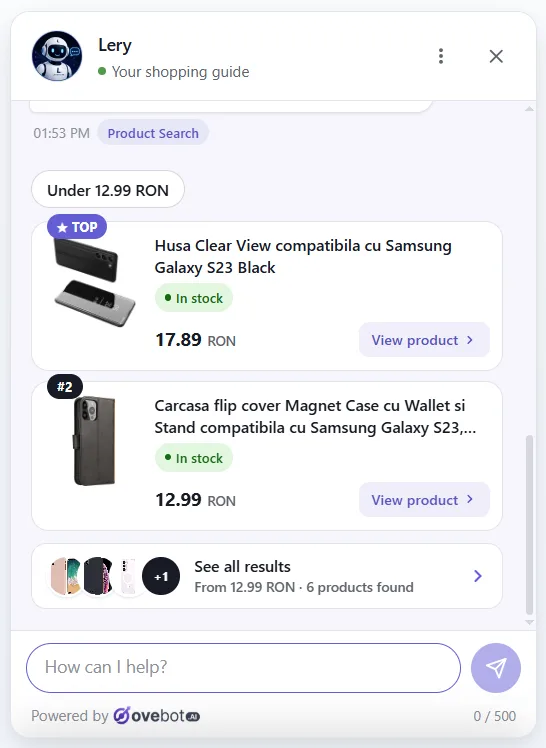
The two screenshots below come from Ovebot, an AI chat assistant that answers from a store’s own knowledge base.

The return policy is a separate entry, next to the returns form and the delivery page. Each entry has an “Updated” date, so the team can check that the assistant uses the current version.

The answer gives the 14-day return window from the date of receipt, which matches the law. It also repeats a second number from the policy, “60 working days for product replacement,” without context. The assistant reports what the text says, so the fix belongs in the policy: state which situation the 60 days covers. That is the last mistake in the list above, caught by a single test question.
Frequently asked questions
Is a 14-day return policy required by law in the EU?
Yes, for distance sales to consumers. You can offer a longer period than 14 days, never a shorter one. Business-to-business sales and in-store purchases follow different rules.
When does the 14-day withdrawal period start?
The period expires 14 days after the customer, or a person they name other than the carrier, acquires physical possession of the goods (the last parcel of a split order).
Who pays return shipping in the EU?
For change-of-mind returns, the customer pays only if you said so before the purchase. For faulty goods, the seller pays.
Can a store refuse returns of opened or personalized items?
Personalized goods, yes. Opened ordinary products, no: you can deduct for loss of value caused by use beyond testing, but you can’t refuse the return. The hygiene exception (Art. 16(e)) is narrow; check your national guidance before relying on it.
How long does a seller have to refund a return?
Within 14 days of being told about the withdrawal, though the seller can wait for the goods or proof of sending, whichever comes first.
Publishing a policy that holds up
A clear return policy states the 14-day right, keeps faulty goods under the 2-year guarantee, and gives every deadline a number and a start event. Fill in the return policy template, test it with five real shopper questions, and publish the same version everywhere customers and your chat assistant will look.
About this guide: written by the Ovebot team, the developers, ecommerce specialists and support staff who build the product and talk with store owners every day. Facts are checked against the sources listed below. About us · Contact
Sources
- EUR-Lex – Directive 2011/83/EU on consumer rights – 2011 – https://eur-lex.europa.eu/eli/dir/2011/83/oj/eng
- EUR-Lex – Directive (EU) 2023/2673 (CELEX 32023L2673), adding Article 11a on the withdrawal function – 2023 – https://eur-lex.europa.eu/eli/dir/2023/2673/oj
- EUR-Lex – Directive (EU) 2019/2161, amending Article 16(m) of Directive 2011/83/EU – 2019 – https://eur-lex.europa.eu/eli/dir/2019/2161/oj
- EUR-Lex – Directive (EU) 2019/771 on contracts for the sale of goods – 2019 – https://eur-lex.europa.eu/eli/dir/2019/771/oj
- Your Europe (European Union) – Returning goods bought online – checked 2026 – https://europa.eu/youreurope/citizens/consumers/shopping/returns/index_en.htm
- Your Europe (European Union) – Guarantees and returns – checked 2026 – https://europa.eu/youreurope/citizens/consumers/shopping/guarantees-returns/index_en.htm
- European Commission – More than half of second-hand online traders fail to meet EU consumer laws – 2025 – https://commission.europa.eu/news-and-media/news/protecting-eu-consumers-more-half-second-hand-online-traders-fail-meet-eu-consumer-laws-2025-03-10_en
- Baymard Institute – Cart abandonment rate statistics – 2025 – https://baymard.com/lists/cart-abandonment-rate
- National Retail Federation and Happy Returns – 2025 Retail Returns Landscape – 2025 – https://nrf.com/media-center/press-releases/consumers-expected-to-return-nearly-850-billion-in-merchandise-in-2025
This article was written with the help of artificial intelligence and reviewed by a human editor.