GDPR chatbot checklist for EU online stores (2026)
A 13-point GDPR chatbot checklist for EU online stores: AI Act disclosure, legal basis, cookies, DPA, transfers, retention and vendor questions.

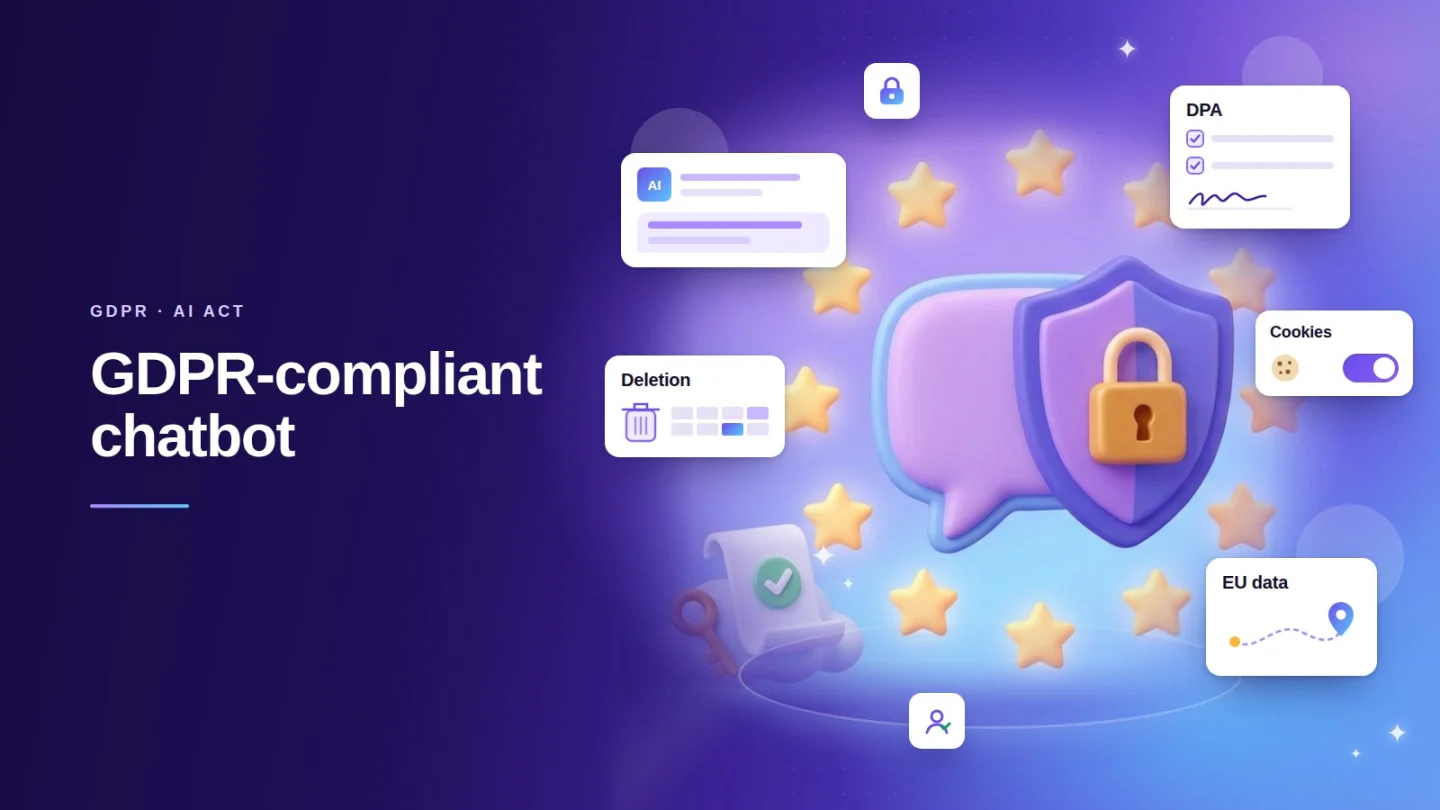
A GDPR chatbot for an online store is one that tells visitors they are talking to AI, has a legal basis for every purpose, collects only what it needs, deletes it on schedule, and runs on a vendor bound by a data processing agreement. None of that is exotic. Most of it is the same GDPR work you already did for checkout and email, applied to a new channel.
Two things changed recently. The EU AI Act’s transparency rule for chatbots has applied since August 2, 2026, and regulators have started fining chatbot companies directly. If you are still deciding whether a chatbot fits your store at all, start with our complete guide to ecommerce chatbots.
This checklist gives you 13 items in a table, then explains each one with the legal reference behind it. It closes with questions to send your vendor before you sign. It is practical guidance, not legal advice: for anything specific to your store, check with your data protection officer or a lawyer.
Key Takeaways
- Visitors must be told they are chatting with AI. AI Act Art. 50(1) has applied since August 2, 2026.
- Pick a GDPR legal basis per purpose: contract for order support, legitimate interest for general product questions.
- Sign a DPA with the chatbot vendor and check that its sub-processor list names the LLM provider.
- Set retention periods for chat logs and let visitors get or delete their transcripts.
- Regulators act on chatbots: Italy’s Garante fined the company behind Replika €5 million in 2025.
The 13-point GDPR chatbot checklist
Use this table as a launch review for your chatbot. Each row is explained in the numbered sections below.
| # | Item | What to do | Legal reference |
|---|---|---|---|
| 1 | AI disclosure | Tell visitors they are chatting with AI when the chat opens | AI Act Art. 50(1) |
| 2 | Legal basis per purpose | Contract for order support, legitimate interest for general Q&A | GDPR Art. 6 |
| 3 | Privacy notice | Link it from the widget, in plain language | GDPR Art. 12-13 |
| 4 | Cookies and local storage | Get consent, or store only what is strictly necessary, or load the widget on click | ePrivacy Art. 5(3), EDPB Guidelines 2/2023 |
| 5 | Minimization and retention | No card numbers or health data in chat; delete logs on a schedule | GDPR Art. 5(1)(c), 5(1)(e) |
| 6 | DPA and sub-processors | Sign a DPA; check the list includes the LLM provider | GDPR Art. 28 |
| 7 | Data location and transfers | Know where data sits and what covers transfers outside the EU | GDPR Art. 44-46, EU-US DPF |
| 8 | Access and erasure | Export or delete a visitor’s transcripts on request | GDPR Art. 15, 17 |
| 9 | Human handoff | Route refunds, disputes and complaints to a person | GDPR Art. 22 (limited scope) |
| 10 | Security | Access control, encryption, staff accounts, incident process | GDPR Art. 32 |
| 11 | DPIA where risk is high | Assess risk before launch if the chatbot handles sensitive cases | GDPR Art. 35, CNIL recommendations |
| 12 | Staff AI literacy | Take measures to promote AI literacy among the staff who configure and supervise the bot | AI Act Art. 4 |
| 13 | Minors | Plan for younger visitors in language and data collection | GDPR Art. 8, 12(1) |
Before launch: transparency and legal basis
These four items decide what visitors see in the first second and whether your chatbot may process their messages at all.
1. Tell visitors they are talking to AI
Show a short AI notice when the chat window opens. Article 50(1) of the AI Act says AI systems that interact with people must let them know they are dealing with AI, unless that is obvious to a reasonably well-informed person. The Commission’s AI Act Service Desk summarizes the rule, and Article 113 sets August 2, 2026 as the date of general application.
The duty in Art. 50(1) sits with the provider, meaning the company that builds the chatbot. You still choose the settings, though. A bot with a human first name, a stock photo and no notice could undo a disclosure the vendor built in. One plain line works: “I am an AI assistant and can make mistakes.”

The Commission’s AI Act timeline puts the high-risk rules for Annex III systems on December 2, 2027. A store chatbot that answers product and order questions is normally not a high-risk system, so transparency and AI literacy are the AI Act duties most stores face.
2. Choose a legal basis for each purpose
Write down one legal basis per purpose, not one for “the chatbot.” GDPR Art. 6 lists six. Two cover most store chats:
- Contract (Art. 6(1)(b)) for order support: tracking a parcel, changing an address, cancelling an order.
- Legitimate interest (Art. 6(1)(f)) for general questions about products, shipping and returns. Document a balancing test: your interest, why chat is needed for it, and why the visitor’s interests and rights do not override it.
The CNIL’s recommendations on AI and GDPR, written for AI developers, use a conversational assistant as an example where legitimate interest can generally apply. Applying that reasoning to a store that deploys a vendor’s chatbot is our reading, not the CNIL’s. The EDPB’s Opinion 28/2024 (December 2024) explains how that test applies to AI models. Separate purposes, like adding a chat lead to your newsletter, follow their own rules and often need consent.
3. Link the privacy notice from the widget
Put a privacy notice link inside the chat, next to the AI notice. Art. 13 requires you to tell people, at the time you collect their data, who the controller is, why you process it, the legal basis, recipients, transfers, retention and their rights. Art. 12 adds that this must be concise and in clear, plain language.
Your notice should name the chatbot vendor as a processor and say whether messages go to an AI model provider. A generic site policy that never mentions chat leaves visitors guessing.
4. Handle cookies and local storage
Check what the widget stores on the visitor’s device before the visitor clicks anything. ePrivacy Directive Art. 5(3) requires consent to store or read information on a device, unless it is strictly necessary for a service the user asked for. The EDPB Guidelines 2/2023 (version 2.0, October 2024) confirm the rule covers local storage and similar techniques, not only cookies.
You have three workable options:
- Load the chat only after the visitor clicks the chat button, so storage serves a service they requested.
- Limit the widget to a single first-party session identifier needed for the conversation, set only once the visitor opens the chat.
- Put the widget behind your consent banner if it sets analytics or advertising cookies.
Data handling: what you collect, keep and share
The next three items follow a chat message through your chatbot, from typing to deletion.
5. Collect less and delete on a schedule
Tell visitors not to type card numbers, passwords or health details, and don’t ask for them. GDPR Art. 5(1)(c) requires data to be limited to what is necessary, and Art. 5(1)(e) bars keeping it longer than needed. For order lookups, an order number plus the email or phone used at checkout is usually enough.
GDPR sets no fixed retention period, so you set one and justify it. An example policy, not a legal rule: delete general Q&A transcripts after a set number of months, and keep order-related chats as long as the order records they support. Then confirm the vendor actually deletes on that schedule, including backups.
6. Sign a DPA and read the sub-processor list
Sign a data processing agreement (DPA) with the chatbot vendor before going live. Under GDPR Art. 28, you are the controller and the vendor is your processor. The DPA must cover instructions, confidentiality, security, sub-processors, assistance with rights requests, and deletion at the end of the contract.
Open the sub-processor list and look for the large language model (LLM) provider. If messages go to an AI model company and it is not listed, ask why.
7. Know where data is stored and how transfers are covered
Ask where chat data is stored and processed, and what legal tool covers any transfer outside the EU. GDPR Art. 44-46 allow transfers to countries with an adequacy decision or with safeguards such as standard contractual clauses. For the US, the European Commission adopted the EU-US Data Privacy Framework adequacy decision on July 10, 2023. It covers transfers to US companies certified under the framework, so check the certification, not just the country.
Storage location and model inference location are often different. A vendor can keep transcripts in the EU while sending each message to a model hosted elsewhere.
Visitor rights and human oversight
Visitors keep their GDPR rights in the chat, and some decisions should stay with your team.
8. Export or delete transcripts on request
Make sure you can find, export and delete one visitor’s chats. GDPR Art. 15 gives people a right of access to their data, and Art. 17 a right to erasure. Your chat setup needs a tested path for both. Before launch, search for a session, export it, delete it, and check in the admin panel that no messages or personal data are left in it. A self-service option in the widget can also cut the number of requests your team handles by email.
9. Hand refunds, disputes and complaints to a person
Route money decisions and complaints to a human. GDPR Art. 22 limits decisions based solely on automated processing that produce legal or similarly significant effects. Most chatbot answers, like a size recommendation, fall outside it. A fully automated refusal of a refund or warranty claim gets closer to that line.
Our recommendation is simple: let the bot collect facts and pass the case to your team. A handoff also limits the damage from wrong answers, covered in our guide to AI hallucinations in customer support.
Security, risk and your team
The last four items protect chat data, assess risk before launch, and prepare the people and visitors involved.
10. Secure the chat and the admin panel
Treat chat transcripts like order data. GDPR Art. 32 requires security appropriate to the risk. In practice that means:
- Separate admin accounts per staff member, with roles and strong authentication.
- Encryption in transit and at rest.
- An incident process that covers the chat vendor.
- Limits on what the bot can do in your store without verification.
That last point matters more as bots gain the ability to act, not just answer. Our explainer on what an AI agent is covers why actions need stronger checks than answers.
11. Run a DPIA when risk is high
Do a data protection impact assessment (DPIA) if your chats touch sensitive situations. GDPR Art. 35 requires one when processing is likely to result in a high risk. The CNIL recommends DPIAs for AI systems where risk is high. Those recommendations are written for AI developers; applying them to a store deploying a vendor’s chatbot is our reading. A pharmacy, an adult store or a shop for children’s products should take this step seriously.
The EDPB Support Pool of Experts report on LLM privacy risks (April 2025) uses a customer-query chatbot as its first use case. It is not an official EDPB position, but it is a useful template for listing risks and mitigations.
12. Train the staff who run the bot
Take measures to promote AI literacy among the people who set up and supervise the chatbot. AI Act Art. 4 on AI literacy has applied since February 2, 2025. After the 2026 amendment, providers and deployers must “take measures to promote” AI literacy among their staff. It is an obligation to take measures, not to guarantee a set level of knowledge. A short internal guide works: what the bot can and can’t do, how to review its answers, and when to take over.
13. Plan for minors
Assume some visitors are young, especially if you sell games, fashion or school supplies. GDPR Art. 12(1) asks for extra clarity in information addressed to children. Art. 8 sets 16 as the default age for consent to online services, which member states can lower to 13. Keep the AI notice simple, avoid collecting extra details, and don’t rely on consent from young visitors for marketing.
What enforcement looks like
Italy’s Garante fined Luka Inc., the company behind the Replika chatbot, €5 million in a decision dated April 10, 2025. According to the EDPB’s report on the fine, the breaches involved GDPR Art. 5(1)(a), 6, 12, 13, 5(1)(c), 24 and 25(1). In plain terms: legal basis, transparency, minimization, accountability and data protection by design.
Replika is not a store, but the case turned on the same basics as this checklist: a clear legal basis, a proper notice and limited data.
Questions to ask your chatbot vendor
Send these before you sign. The answers show whether a product can meet these requirements in your store, and written replies are easy to file as evidence of your due diligence.
- Does the widget show an AI disclosure when the chat opens, and can we accidentally turn it off?
- Can you send your DPA and current sub-processor list? Is the LLM provider on it?
- Where are transcripts stored, and where is each message processed by the model?
- What covers transfers outside the EU: DPF certification, standard contractual clauses, or both?
- Are personal details like emails and phone numbers removed before messages reach the model?
- Is our chat data used to train your models or anyone else’s?
- What does the widget store on the visitor’s device before and after they open the chat?
- Can we set retention periods, and does deletion include backups?
- Can visitors download or delete their own conversations? Can we export or delete one session?
- How does handoff to a human work, and what happens outside our working hours?
- Which security measures protect the admin panel, and how will you notify us of an incident?
What this looks like in practice
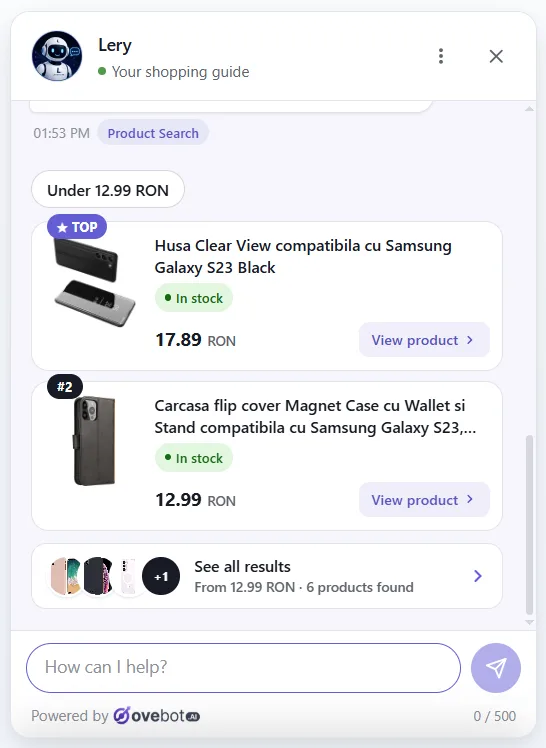
One vendor, Ovebot (the company that publishes this blog), handles several items on the list as shown below. It is one example, not the only way to meet them.


Behind the screens, Ovebot stores data in EU data centers and filters personal identifiers such as emails, phones and addresses before messages reach the global LLM providers it uses. The widget sets a single first-party session token, with no advertising cookies. A public DPA and sub-processor list cover item 6.
Frequently asked questions
Is a chatbot GDPR compliant if it uses a US LLM?
It can be, if the transfer is covered by the EU-US Data Privacy Framework or standard contractual clauses and the model provider appears on your vendor’s sub-processor list. See item 7.
Do I need cookie consent for a chat widget?
Not if the widget loads on click, keeps only one session identifier set once the visitor opens the chat, and doesn’t read other information from the device before the visitor opens the chat. Analytics or advertising cookies need consent. See item 4.
Does the AI Act require telling customers they talk to a bot?
Yes, since August 2, 2026, unless it is obvious. A short notice when the chat opens covers it. See item 1.
How long can I keep chat logs?
GDPR sets no fixed number. Set and document your own periods (item 5), and keep chats linked to an open dispute or warranty claim until that case is closed.
Do I need a DPA with my chatbot provider?
Yes. The vendor is your processor, so GDPR Art. 28 requires a written contract. See item 6.
Your next step
A compliant chatbot rests on the same basics as the rest of your store: tell people what happens, keep only what you need, and sign the right contracts. Start with the vendor questions above, then work through the table one row at a time before launch.
About this guide: written by the Ovebot team, the developers, ecommerce specialists and support staff who build the product and talk with store owners every day. Facts are checked against the sources listed below. About us · Contact
Sources
- EUR-Lex – Regulation (EU) 2016/679 (General Data Protection Regulation) – 2016 – https://eur-lex.europa.eu/eli/reg/2016/679/oj
- EUR-Lex – Regulation (EU) 2024/1689 (Artificial Intelligence Act) – 2024 – https://eur-lex.europa.eu/eli/reg/2024/1689/oj
- European Commission, AI Act Service Desk – Article 50: Transparency obligations – 2026 – https://ai-act-service-desk.ec.europa.eu/en/ai-act/article-50
- European Commission, AI Act Service Desk – Article 113: Entry into force and application – 2026 – https://ai-act-service-desk.ec.europa.eu/en/ai-act/article-113
- European Commission, AI Act Service Desk – Article 4: AI literacy – 2026 – https://ai-act-service-desk.ec.europa.eu/en/ai-act/article-4
- European Commission – AI Act: regulatory framework and timeline – updated 2026 – https://digital-strategy.ec.europa.eu/en/policies/regulatory-framework-ai
- EUR-Lex – Directive 2002/58/EC (ePrivacy Directive) – 2002 – https://eur-lex.europa.eu/eli/dir/2002/58/oj
- EDPB – Guidelines 2/2023 on the technical scope of Art. 5(3) of the ePrivacy Directive, version 2.0 – 2024 – https://www.edpb.europa.eu/our-work-tools/documents/public-consultations/2023/guidelines-22023-technical-scope-art-53-eprivacy_en
- EDPB – Opinion 28/2024 on certain data protection aspects related to AI models – 2024 – https://www.edpb.europa.eu/our-work-tools/our-documents/opinion-board-art-64/opinion-282024-certain-data-protection-aspects_en
- EDPB Support Pool of Experts – AI Privacy Risks & Mitigations: Large Language Models – 2025 – https://www.edpb.europa.eu/our-work-tools/our-documents/support-pool-experts-projects/ai-privacy-risks-mitigations-large_en
- CNIL – AI system development: CNIL’s recommendations to comply with the GDPR – 2026 – https://www.cnil.fr/en/ai-system-development-cnils-recommendations-to-comply-gdpr
- European Commission – EU-US data transfers – 2023 – https://commission.europa.eu/law/law-topic/data-protection/international-dimension-data-protection/eu-us-data-transfers_en
- EDPB – AI: the Italian Supervisory Authority fines company behind chatbot Replika – 2025 – https://www.edpb.europa.eu/news/ai-the-italian-supervisory-authority-fines-company-behind-chatbot-replika_en
This article was written with the help of artificial intelligence and reviewed by a human editor.