Chatbot human handoff: when and how to escalate to a person
Chatbot human handoff for online stores: when the AI should pass a chat to a person, what to hand over, out-of-hours rules and what EU law requires.

A chatbot human handoff is the moment your store’s AI assistant passes a conversation, with everything said so far, to a person on your team. It should happen when a shopper asks for a person, when the bot can’t answer, or when the request needs someone with authority, such as a custom discount. Without that exit, shoppers get stuck in what the US Consumer Financial Protection Bureau calls “doom loops.”
Shoppers expect the exit. In a 2026 Gartner survey of 3,566 customers, 87% said it’s essential for companies using generative AI in service to offer a way to reach a human agent (destinationCRM). Only 27% would try a chatbot again after a bad experience (IT-Online).
We build Ovebot, an AI sales and support agent for online stores, so the product parts of this guide are shown with our own screens.
About this guide: Written by the Ovebot Team, the developers, ecommerce specialists and support staff who build Ovebot and talk to store owners every day. Every number about the market comes from the public sources listed at the end, and product details describe Ovebot’s own features.
Key Takeaways
- A good chatbot human handoff passes the whole conversation to a person, so the shopper never starts over.
- Escalate on clear triggers: a request for a person, two failed answers, frustration, money exceptions, unverifiable order problems, unknown products, legal or safety issues and large B2B deals.
- Escalate early. A randomized experiment published in 2026 found human takeover worked less well once the customer was already frustrated.
- Outside working hours, don’t promise a person. Show your contact details and collect the shopper’s.
- EU chatbots must disclose they’re AI from August 2, 2026, unless it’s obvious. No general EU right to reach a human exists yet for online shops.
What is a chatbot human handoff?
A chatbot human handoff is a transfer: the AI answers first, and when a conversation needs a person, it passes the chat and its history to a team member who continues in the same window. The team member reads the transcript instead of asking “How can I help you?” again.
Handoffs come in two forms:
- Warm handoff. A person joins the live chat while the shopper is still there, with the full conversation in view.
- Cold handoff. The bot collects contact details, and the team replies later by email or phone.
Both are valid. The failure is promising a warm handoff and delivering a cold one, or nothing at all. Outside working hours, nobody can join the chat, so an honest bot says so and collects details for a later reply.
Why shoppers need a route to a person
A visible route to a person keeps shoppers willing to use the bot at all. The 2026 Gartner survey shows real demand for AI service next to fragile trust.
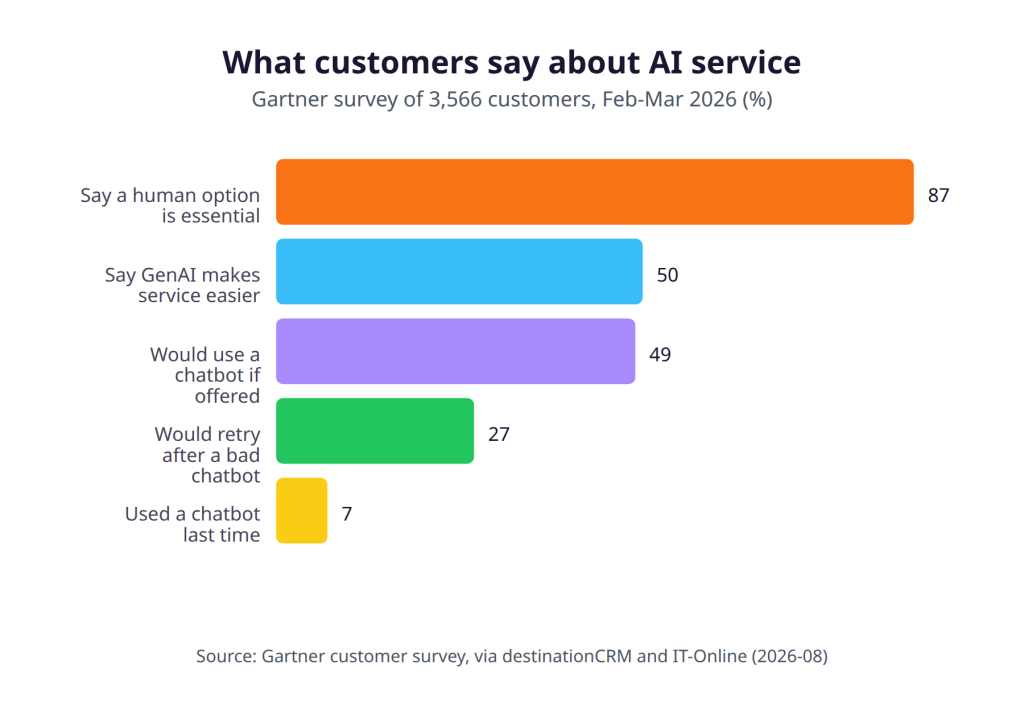
Half of customers said generative AI makes their interactions easier, and 49% would have used a chatbot if one had been offered. Yet only 27% would try a chatbot again after a bad experience.
Regulators and consumer bodies see the same risk. In a 2023 report, the CFPB warned about “doom loops” of repetitive, unhelpful answers and about bots with no “offramp” to a human. In Europe, the European Consumer Centres Network reported in 2023 that consumers “regret that chatbots or automated systems are the only way to get in touch with some traders.”
In one large study, AI made support staff more productive instead of replacing them. In a study of 5,172 support agents, published in the Quarterly Journal of Economics in 2025, agents with an AI assistant resolved 15% more issues per hour, and about 30% more for less-skilled agents (Brynjolfsson, Li and Raymond). Customers were also more polite and less likely to ask for a manager.
Escalation triggers: when a person should take over
A chatbot should escalate when a person can resolve something the bot can’t. The problems EU shoppers report show where that line falls. In 2025, 63% of online shoppers aged 16-74 reported no problems. These were the most common problems, as a share of all online shoppers:
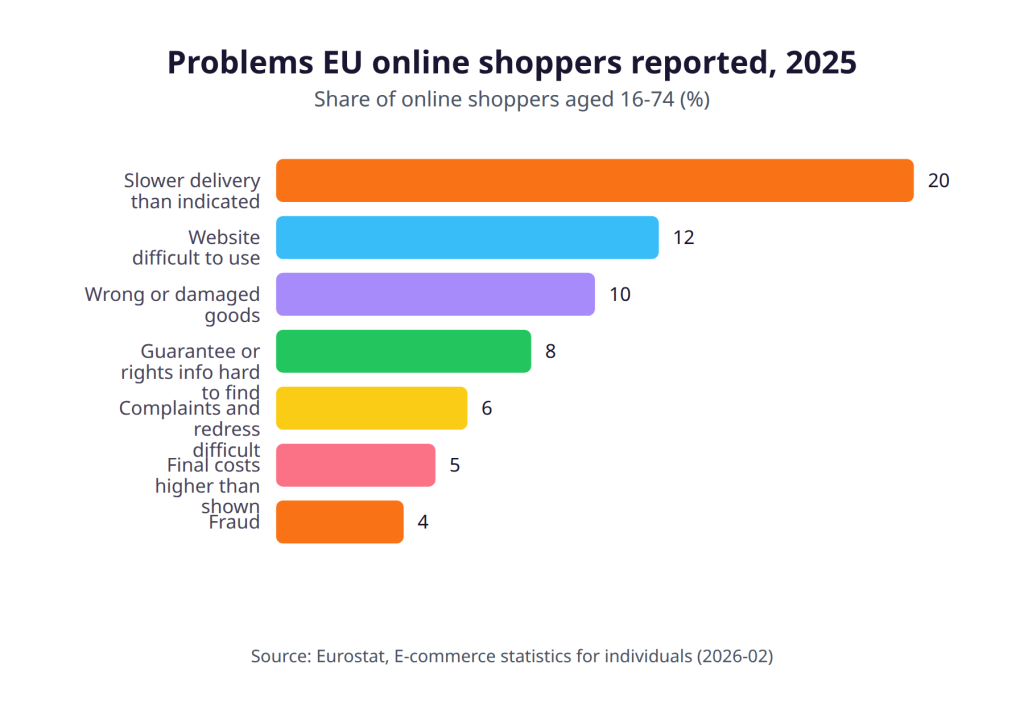
Slow delivery, the top problem in Eurostat’s data, is often a status question a bot can answer from live order data. Wrong or damaged goods, complaints and fraud are different. Our recommendation: route those to a person who can look at photos, approve a replacement or contact the payment provider.
| Trigger | What a shopper might type | What the bot should do |
|---|---|---|
| Asks for a person | “Can I talk to a real person?” | Offer a person at once, no extra questions |
| Same question fails twice | “That’s not what I asked. Does it fit the 2019 model?” | Admit it can’t answer and offer a person |
| Frustration or a complaint | “This is the third time I’m asking about my refund.” | Acknowledge it once, then hand over |
| Money exceptions | “Can you give me 15% off if I order 40?” | Promise nothing; pass it to someone who can approve |
| Order or payment problems it can’t verify | “I was charged twice for the same order.” | Ask for the order number, then hand over |
| Questions outside the knowledge base | “Will you stock the next-generation graphics card?” | Say it can’t confirm, and offer the team’s contact |
| Legal, safety or health | “The charger got hot and melted the cable. Is that dangerous?” | Don’t guess; route to a person right away |
| High-value B2B orders | “We need a quote for 200 laptops, invoiced to our company.” | Collect the details and hand over to sales |
Refunds outside your policy belong in the money row too: “My return window closed last week. Can I still send it back?”
Timing matters as much as the trigger. In a randomized experiment on Taobao customer service (647 agents, 680,676 chats in August 2024), human takeover preserved service quality when the AI escalated because it hit a technical limit (Wang et al., arXiv preprint, 2026). When the AI escalated after the customer was already frustrated, the takeover was less effective. The authors conclude that early intervention is essential. Our rule of thumb: hand over at the second failed answer, not the fifth.
What the bot should keep answering
The bot should keep the questions it can answer from your own data. Escalating them wastes your team’s time and makes shoppers wait for something they could have had instantly.
| Question type | Example | Where the answer comes from |
|---|---|---|
| Order status | “Where is order 10452?” | A live order lookup (see order tracking in chat) |
| Shipping times | “How long does delivery to Austria take?” | Your shipping page |
| Returns policy | “Can I return an opened item?” | Your returns policy |
| Product questions | “Does this charger fit my laptop?” | Your product catalog and specs |
If the bot gets one of these wrong, fix the source page rather than adding a handoff rule.
The handoff flow, step by step
A reliable handoff follows the same path every time, and your working hours decide which branch the shopper takes.
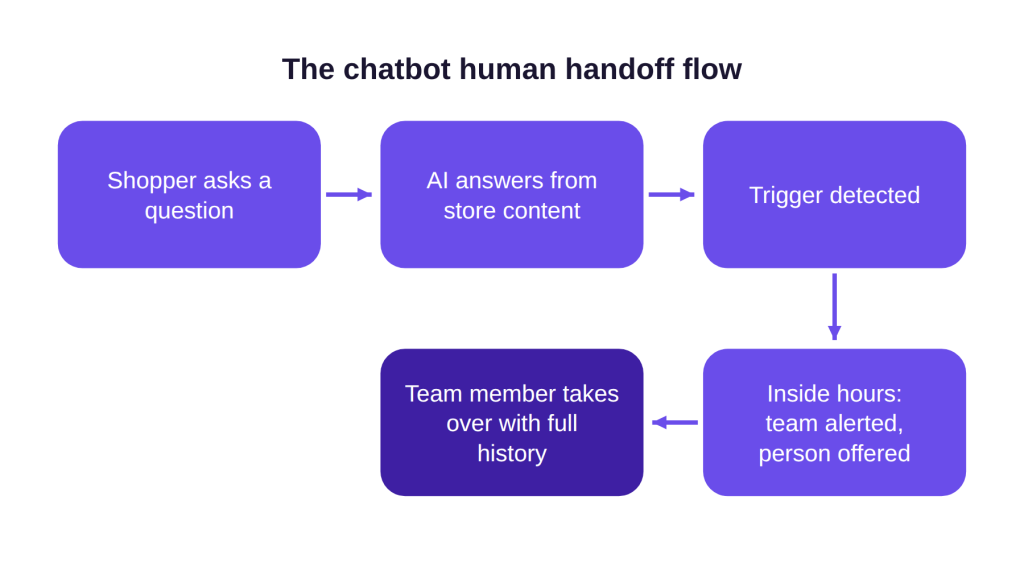
The shopper should always know which branch they’re on. “A team member will join this chat” and “We’ll email you tomorrow morning” are both fine answers. Silence is not.
How to set up a chatbot human handoff in 6 steps
Setting up a chatbot human handoff comes down to six decisions: triggers, disclosure, context, alerts, out-of-hours behavior and feedback into the bot.
1. Set your triggers
Start from the trigger table above and adapt it to your store. Decide who receives each type: discounts and B2B quotes might go to sales, payment problems to whoever handles refunds. Write the list down so the whole team handles the same cases the same way.
2. Disclose the AI and keep the human route visible
Tell shoppers they’re talking to AI, and show them how to reach a person. Article 50(1) of the EU AI Act requires that people be informed they’re interacting with an AI system, unless that’s obvious from the context. It applies from August 2, 2026.
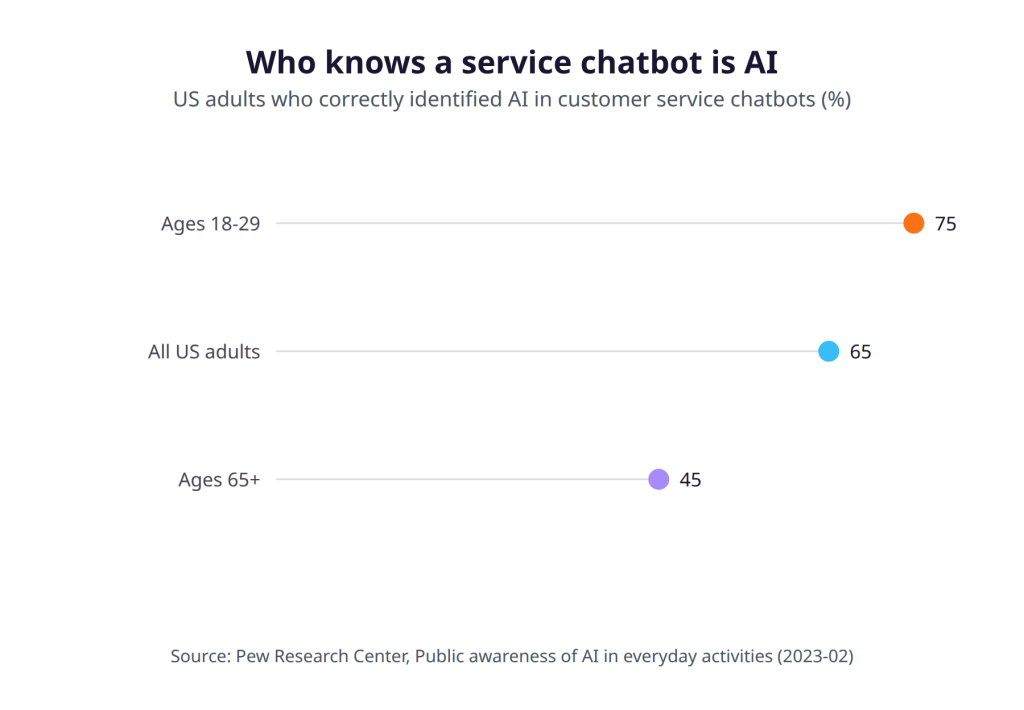
Don’t assume shoppers already know. In a 2023 Pew Research Center survey of 11,004 US adults, 65% correctly identified that customer service chatbots use AI, and awareness dropped sharply with age.
Disclosure has a cost worth knowing. A 2019 field experiment with more than 6,200 customers on outbound sales calls found that disclosing the chatbot before the conversation cut purchase rates by more than 79.7% (Luo et al., Marketing Science). Later disclosure and prior AI experience softened the effect. In the EU, the AI Act now requires disclosure, so the lesson is to disclose clearly, make the bot good enough to earn trust and keep the route to a person in plain sight.
3. Pass the full context so nobody repeats themselves
The person who takes over should see everything the shopper already said. Pass:
- The full transcript, not only a summary
- The trigger: why the bot handed over
- The shopper’s language
- The page or product they were looking at
- The order number, if the shopper gave one
- Contact details, if the shopper chose to leave them
Pass only what your team member needs. A handoff is no reason to copy payment data into a chat log.
4. Notify fast and promise a reply time you can keep
A handoff only helps if someone sees it. Turn on alerts for whoever is on duty, and decide who covers breaks and busy hours.
Then tell the shopper what happens next. We don’t quote an industry benchmark for reply times; the honest target is the one your team meets every day. A holding message you can adapt:
“Thanks, I’ve passed this to our team. Someone will reply right here during our hours, Monday through Friday, 9 a.m. to 6 p.m. If you’d rather get an email, leave your address below.”
5. Handle out-of-hours requests honestly
Outside working hours, don’t offer a person who isn’t there. Show your contact details, collect the shopper’s email or phone and say when you’ll reply.
An answering bot still beats a closed sign. In a 2023 randomized experiment on a cross-border marketplace, a pre-sale AI chatbot raised sales by 16.3% compared with an automated “support unavailable” reply (Fang et al., arXiv preprint). The study isn’t peer reviewed yet. Our guide to 24/7 customer support for small stores covers nights and weekends in more depth.
6. Close the loop: teach the bot what the human answered
Every handoff exposes a gap in the bot’s knowledge. After a person answers a new question, add the answer to the bot’s sources so the next shopper gets it instantly. Grounding the bot in checked content is also the best defense against made-up answers in customer support.
How a chatbot human handoff works in Ovebot
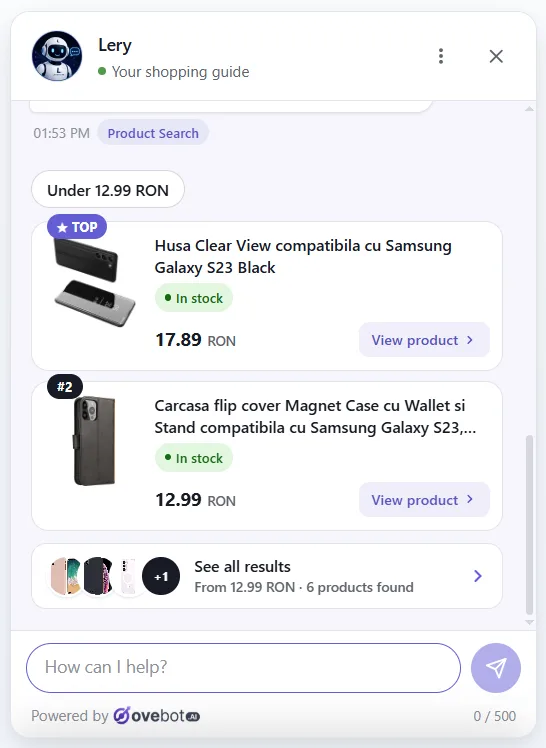
In Ovebot, the AI assistant offers a human only inside the working hours you set, and your team takes over with one click. Outside those hours, it stops offering a person and shows your contact details instead.
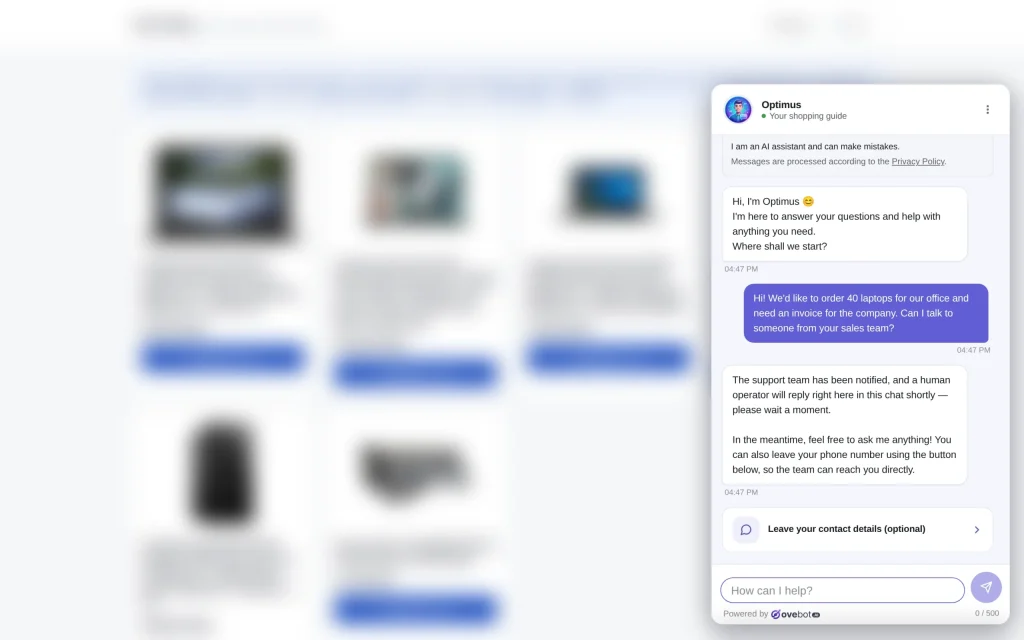
The shopper asked for a person, so the assistant didn’t try to quote the order itself. It told the shopper what happens next and offered an optional way to leave contact details.
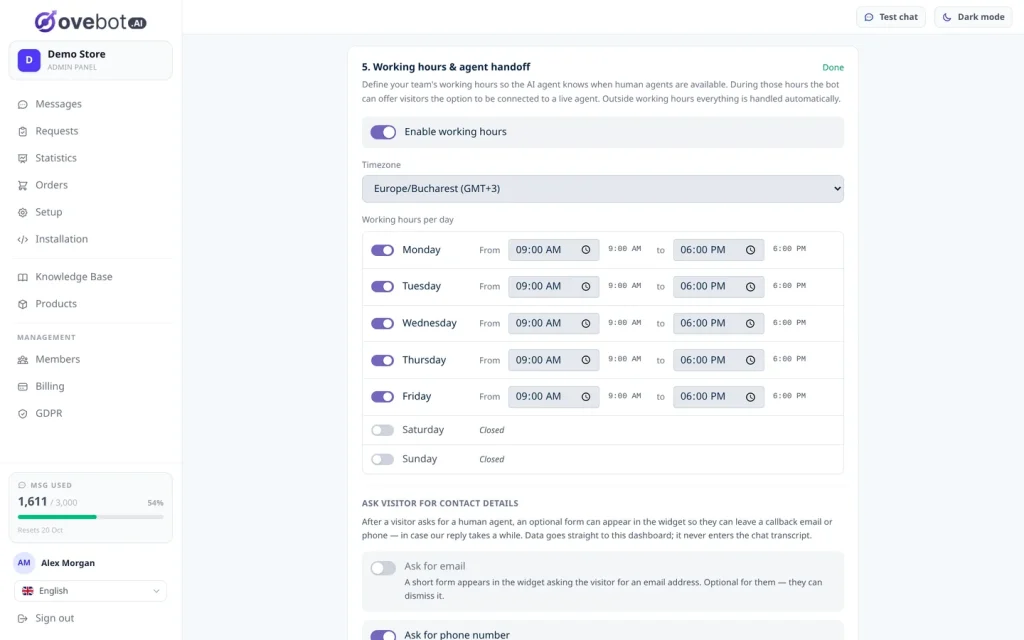
After a visitor asks for a person, an optional form can request an email, a phone number or both, and the visitor can dismiss it. Those details go straight to the dashboard and never enter the chat transcript. Outside hours, visitors can leave their details as a lead.
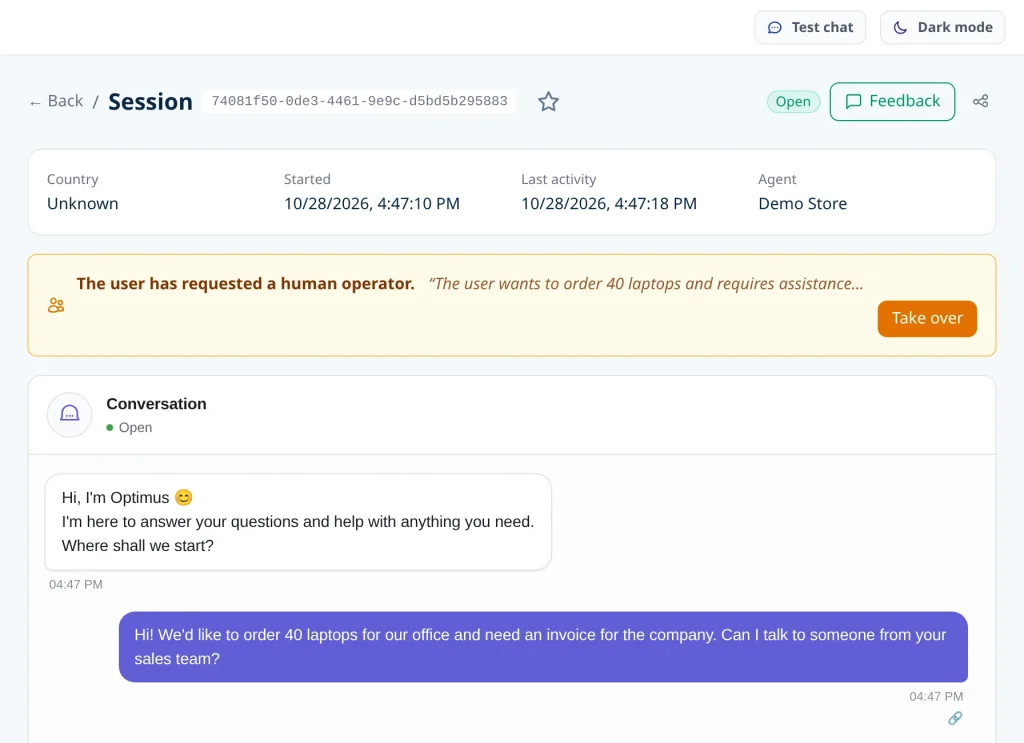
When a visitor needs a person, your team gets a browser notification with sound. The team member sees the whole conversation, takes over with one click and can use quick replies. The assistant works in 29+ languages and detects the visitor’s language automatically.
For step 6, the assistant proposes new facts it hears in chats, and you approve or reject each one before it uses them.
What EU rules say about chatbots and human contact
EU law requires chatbots to disclose that they’re AI, but no general EU rule today gives online shoppers a right to reach a human. Four texts matter:
| Rule | What it requires | Applies to online shops? |
|---|---|---|
| AI Act, Article 50(1) | Inform people they’re interacting with an AI system, unless obvious from the context. From August 2, 2026. | Yes, to chatbots that talk to shoppers |
| GDPR, Article 22 | A right not to be subject to decisions based solely on automated processing with legal or similarly significant effects, with safeguards including human intervention | Only for significant automated decisions, not ordinary chat answers |
| Directive (EU) 2023/2673 | A right to request human intervention when a trader uses online tools such as chatbots. From June 19, 2026. | No, only financial services contracts concluded at a distance |
| Digital Fairness Act | Commission proposal expected in Q4 2026, according to the European Parliament’s research service | Not yet; its content isn’t decided |
A chatbot-only setup isn’t banned for an ordinary store at EU level today, but the Gartner and ECC-Net findings show it’s a risk with shoppers. This is not legal advice; check national rules with a lawyer. For personal data in chats, see our guide to GDPR for AI chatbots.
What to measure after launch
Six numbers show whether your chatbot human handoff works. We don’t give benchmark targets, because no neutral public source sets them for small stores, so compare your own months instead.
| Metric | What it tells you | If it looks off |
|---|---|---|
| Handoff rate | Share of conversations passed to a person | Rising: read transcripts and fill knowledge gaps |
| Handoffs by trigger | Which triggers fire most | Many “outside the knowledge base”: add content |
| Time to first human reply | How long shoppers wait after a handoff | Longer than promised: fix alerts or the promise |
| Conversations resolved by AI | What the bot handles alone | Falling: check recent catalog or policy changes |
| Repeat contacts | Shoppers back about the same issue | Rising: answers aren’t actually resolving |
| Leads captured out of hours | Demand arriving while you’re closed | Many: consider longer hours or faster morning replies |
Read a sample of handed-over chats every week: numbers show where to look, and transcripts show what to fix. In Ovebot, a twice-monthly email report includes conversations and the share resolved by AI.
Frequently Asked Questions
How do you hand a customer from a chatbot to a human agent?
A chatbot human handoff starts with clear triggers, such as a request for a person or two failed answers. During working hours, the bot offers a person and alerts your team, and a team member takes over the same chat with the full conversation in view. Outside working hours, the bot shows contact details and collects the shopper’s email or phone for a later reply.
How fast should a human reply after a handoff?
No neutral public benchmark sets a reply time for small stores, so promise only what your team meets every day. Tell the shopper what happens next, for example that someone will reply in the same chat during your hours, and offer an email option. Then track time to first human reply each month and fix alerts or staffing if you miss your own promise.
Do I have to tell customers they are talking to a chatbot in the EU?
Yes. Article 50(1) of the EU AI Act requires that people be informed they’re interacting with an AI system, unless it’s obvious from the context. The rule applies from August 2, 2026. A clear notice when the chat opens is the simplest way to meet it, and a visible route to a person helps keep trust.
Is it legal to offer only a chatbot for customer service in the EU?
For an ordinary online shop, no general EU rule today requires access to a human. A right to request human intervention applies to financial services contracts concluded at a distance, from June 19, 2026. The Digital Fairness Act proposal is expected in Q4 2026, and its content isn’t decided. National rules may differ, so check with a lawyer.
What happens to handoff requests outside working hours?
A well-designed bot stops offering a live person when nobody is available. It shows the store’s contact details, says when the team will be back and lets the shopper leave an email or phone number. Make sure someone owns those leads, because an unanswered overnight message undoes the trust the handoff was meant to build.
Bottom line: hand over early, and never leave a dead end
A chatbot human handoff works when the bot knows its limits, hands over before the shopper gets frustrated and passes the whole conversation along. Outside working hours, honesty about when a person will reply matters more than speed. If you want working hours, one-click takeover and out-of-hours leads without a developer, try Ovebot with a 14-day free trial on any pricing plan.
Sources
- destinationCRM, Gartner survey: customers want access to human agents when companies use GenAI, 2026
- IT-Online, Gartner survey on chatbot use and bad experiences, 2026
- Consumer Financial Protection Bureau, Chatbots in consumer finance, 2023
- European Consumer Centres Network, Input to the Digital Fairness Fitness Check, 2023
- Pew Research Center, Public awareness of artificial intelligence in everyday activities, 2023
- Brynjolfsson, Li and Raymond, Generative AI at Work (arXiv), Quarterly Journal of Economics, 2025
- Luo, Tong, Fang and Qu, Machines vs. Humans: The Impact of AI Chatbot Disclosure on Customer Purchases, Marketing Science, 2019
- Fang, Yuan, Zhang, Donati and Sarvary, Generative AI and Sales Productivity: Field Experiments in Online Retail (arXiv preprint), 2025
- Wang, Zhu, Feng, Lu and Jia, randomized experiment on AI escalation in Taobao customer service (arXiv preprint), 2026
- Eurostat, E-commerce statistics for individuals, 2026
- EUR-Lex, Regulation (EU) 2024/1689 (AI Act), 2024
- EUR-Lex, Regulation (EU) 2016/679 (GDPR), 2016
- EUR-Lex, Directive (EU) 2023/2673 on financial services contracts concluded at a distance, 2023
- European Parliamentary Research Service, Towards a digital fairness act, 2026
This article was written with the help of artificial intelligence and reviewed by a human editor.