Customer service response time: benchmarks and how to cut it
Customer service response time for online stores: what shoppers live through while they wait, why we found no neutral chat benchmark, and 6 ways to cut it.

Customer service response time is how long a shopper waits between asking a question and getting a useful reply. It counts twice: at the first reply, and again at the final answer, such as the refund or the replacement.
This guide follows one shopper’s wait on a clock, from the second they hit send to a legal deadline that binds payment providers weeks later. Then it shows six ways to cut the wait with the team you already have.
Key Takeaways
- 37% of EU online buyers hit at least one problem with a purchase in 2025. Each one is a likely question.
- 35.9% of callers hung up when told their place in line, against 69.4% of callers who heard music. Telling people where they stand makes a wait easier to bear.
- None of the chat and email reply-time benchmarks we found were neutral. Your own median first response time is the number to beat.
- Answer repeated questions right away with an AI assistant trained on your store’s content, and route the rest to a person with a clear message.
A shopper’s wait, from the first second to the legal ceiling
Each stop below is a point on the clock where research, a public rule or our demo store tells us something about the wait. None of the studies measured shop chat, but they point the same way: slower replies go with lower satisfaction.
0 seconds: the question is sent
The clock starts. Many questions begin with a problem the shopper ran into, such as a late delivery or guarantee information they could not find.
1 minute: repeated questions can already be answered
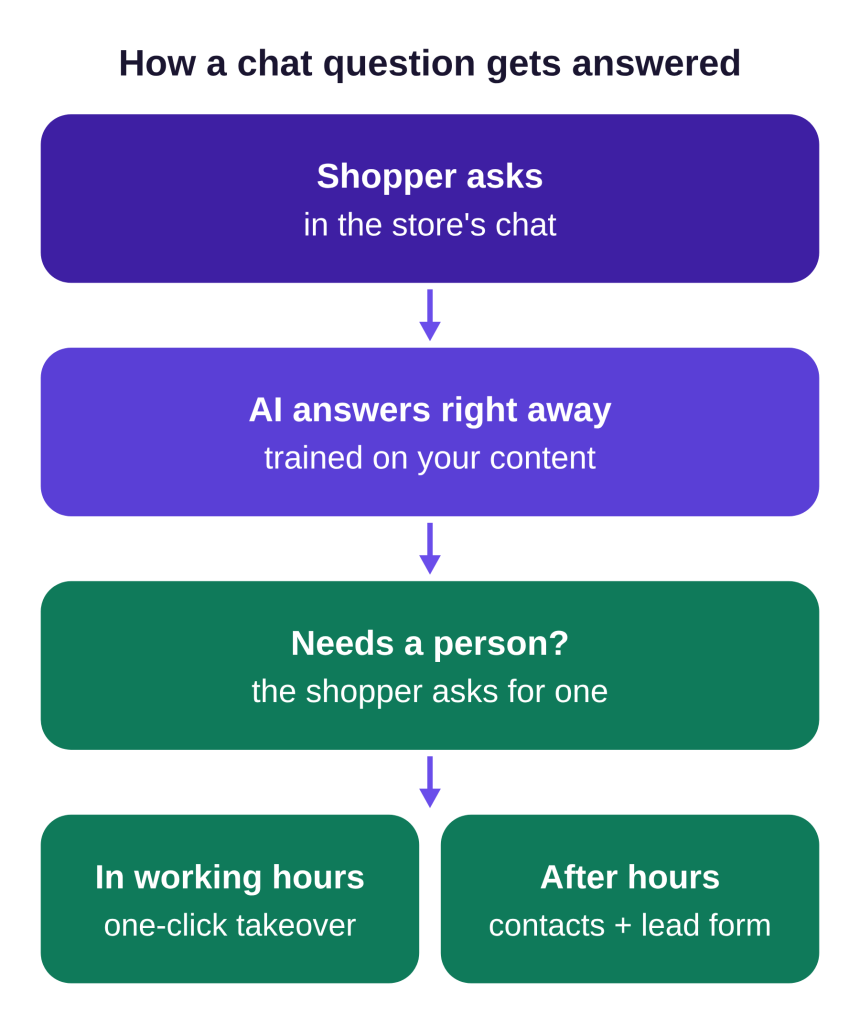
Shipping, returns and warranty questions repeat. An AI assistant trained on your policies can answer them in the same minute, at any hour.
Minutes: a person joins, if the shopper asks
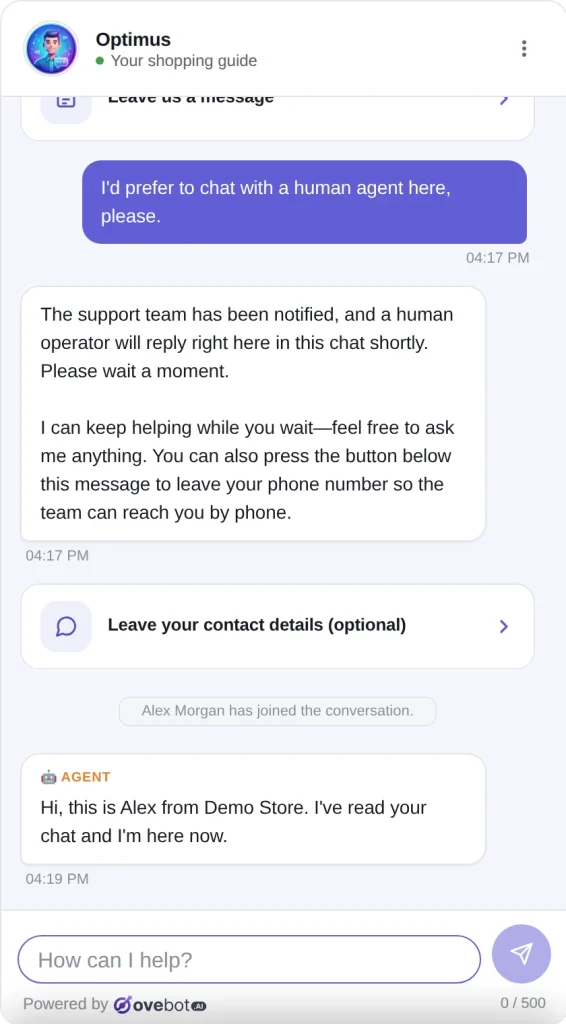
During working hours, a notified team member can take over the chat. On our demo store, a person replied two minutes after the shopper asked for one.
1 to 6 hours: patience on social media runs out
In a 2017 study by Istanbulluoglu, consumers expected a reply to a complaint within 1-3 hours on Twitter (now X) and 3-6 hours on Facebook. A faster first reply and a faster final reply both raised satisfaction, even when the customer received redress.
Hours to days: email complaints are judged on speed
A 2003 study by Mattila and Mount looked at 446 hotel guests who complained by email. Their satisfaction and intention to return were directly related to how long the reply took, and tech-savvy guests expected faster answers.
Beyond complaints, sales leads go cold too: a 2011 Harvard Business Review audit found most US companies were not answering web inquiries nearly fast enough.
15 business days: a legal ceiling for payment providers
EU payment service providers must reply to a complaint within 15 business days, or 35 in exceptional cases with a holding reply (Directive (EU) 2015/2366, Art. 101). A deadline like this is a ceiling for a final answer, not a target for a shop’s chat.
Response time benchmarks: what exists and what doesn’t
The only neutral numbers we found are shopper expectations on social media and reply deadlines that public bodies set for written correspondence. The chat and email figures that circulate come from software vendors’ own surveys, so we leave them out.
| Context | Reply time | Source |
|---|---|---|
| Complaint on Twitter (shopper expectation) | 1-3 hours | Istanbulluoglu, 2017 |
| Complaint on Facebook (shopper expectation) | 3-6 hours | Istanbulluoglu, 2017 |
| Payment service complaints in the EU (legal deadline) | 15 business days; up to 35 in exceptional cases | Directive (EU) 2015/2366, Art. 101 |
| UK government replies to MPs and Peers (target) | 20 working days; 79% met it in 2024 | UK Cabinet Office |
Your best customer service response time benchmark is your own history. Our guide to customer service metrics shows how first response time fits next to the other numbers worth tracking.
Why a wait feels longer than the clock says
How a wait feels depends on what people know while they wait. In a 2007 field study, Munichor and Rafaeli put 123 real phone calls on hold for 108 seconds and compared what callers heard.
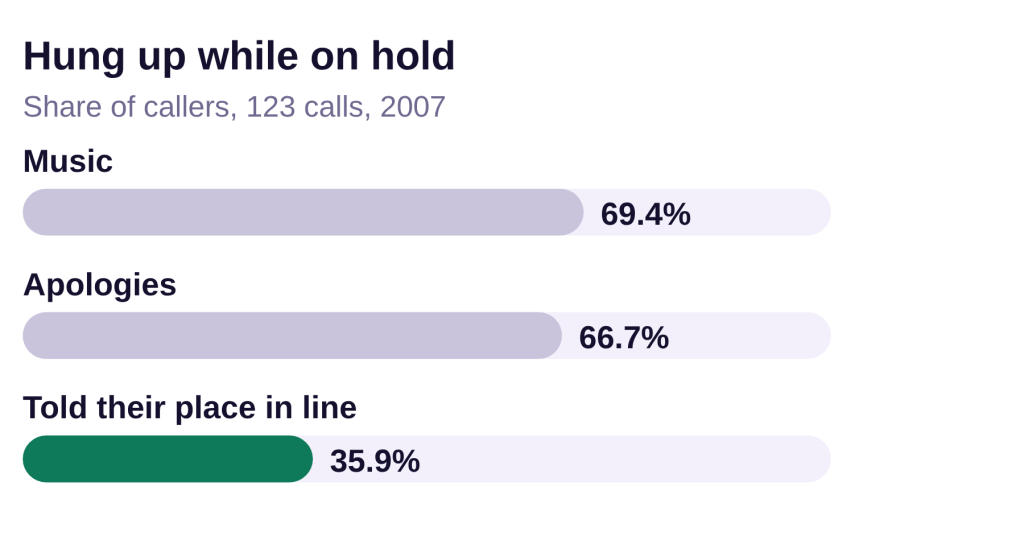
Callers told their place in line (“you are third in line”) hung up least. They were also the most satisfied:
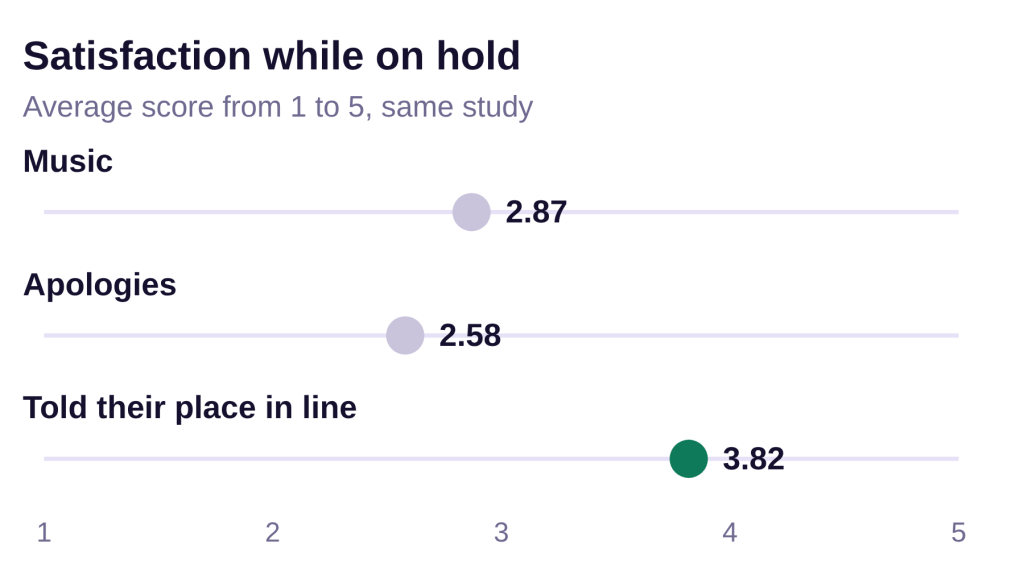
The authors explain it as a sense of progress. David Maister made the same point in 1985, in two of his propositions on waiting:
Uncertain waits are longer than known, finite waits. Unexplained waits are longer than explained waits. David Maister, The Psychology of Waiting Lines
Visible progress helps too: people can prefer a longer wait when they see the work being done (Buell and Norton, 2011). In a separate 2018 experiment, dynamic response delays made a chatbot feel more human. That is about pacing inside a conversation, not about leaving a question unanswered. So cut the wait, and say what is happening during it.
Six ways to cut your customer service response time
Written for a store with one or two people on support. Each step names what it changes: it either removes a wait or makes the remaining wait clear.
1. Measure your median first response time
Take the last two weeks of email and chat and note the time from each first message to the first useful reply. Use the median: one email left over a long weekend distorts a mean. Split working hours and after-hours.
What it does: shows the wait.
2. List the questions that keep coming back
Delivery, guarantees and costs turn into questions like “When will it arrive?” and “How do I make a warranty claim?” Write down your top ten.
What it does: finds the repeats.
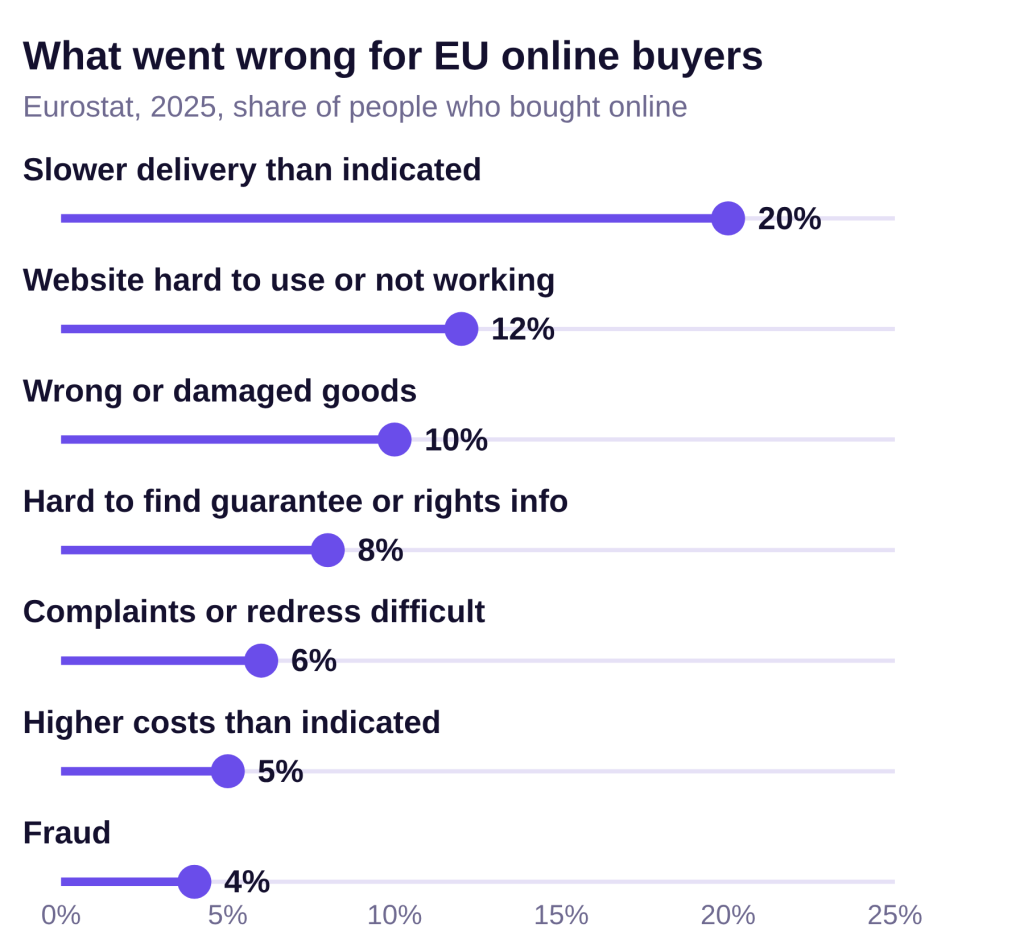
Most repeats start with a problem. In 2025, 78% of EU internet users bought online, and 63% of buyers reported no problem. Among all online buyers, these problems were the most common:
3. Answer repeated questions instantly with AI
An AI assistant trained on your policies and product pages answers the top ten at any hour. Install it through a plugin for your platform, such as the Ovebot plugins for WooCommerce, OpenCart, PrestaShop and Magento, then test every question yourself. Our article on AI hallucinations in customer support covers accuracy.
What it does: removes a wait.
4. Set working hours and be honest after hours
Publish when a person is available. Outside those hours, show contact details and say when you will reply: “We reply by 10 a.m. on the next business day.” For nights and weekends, see 24/7 support without a night shift.
What it does: makes the wait clear.
5. Speed up human replies
Turn on notifications with sound so a waiting shopper isn’t missed. Save quick replies for greetings and common follow-ups so a person starts from a template, not from scratch.
What it does: removes a wait.
6. Tell people what happens next
Every handover should say who will reply, where, and roughly when. That is the place-in-line effect applied to chat.
What it does: makes the wait clear.
The words to use in each case:
| Situation | First reply | What to tell the shopper |
|---|---|---|
| Repeated question (shipping, returns, warranty) | AI, right away | The full answer, with contact details if they need more |
| Needs a person, inside working hours | AI acknowledges, then a person joins | “Our team has been notified and will reply here shortly” |
| Needs a person, outside working hours | AI, right away | Your contact details, when you will reply, a form to leave theirs |
| Complaint by email | Acknowledge the same day | What you will check and when the final answer will come |
Watch the clock on a demo store with Ovebot
Ovebot answers shoppers 24/7 in your store’s chat widget, trained on your own content: pages from URLs, PDF, Word, Excel and CSV files, and manual entries. Here is one afternoon on our demo store, in three screens.
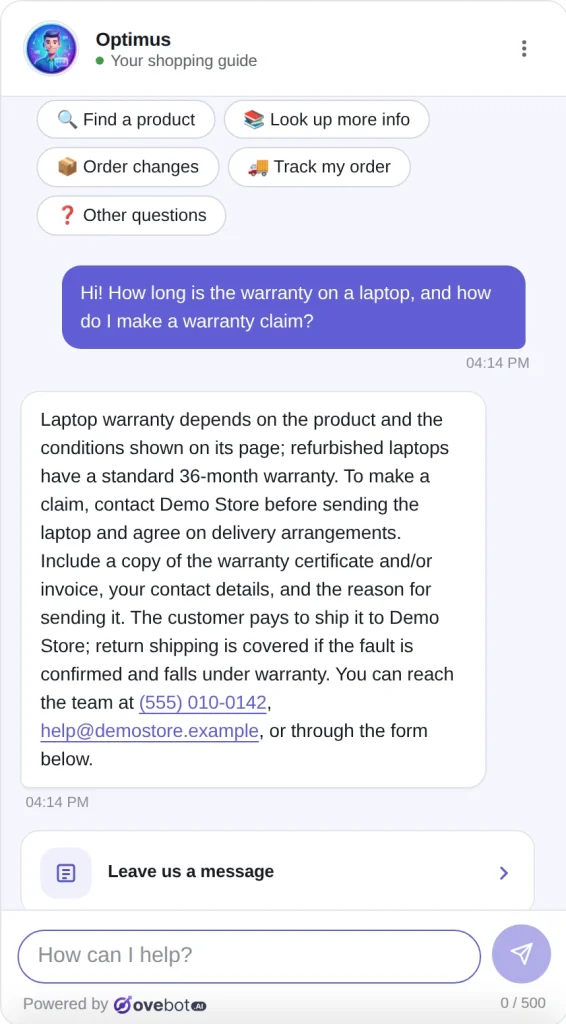
04:14 PM: answered in the same minute
04:17 to 04:19 PM: a person joins in two minutes
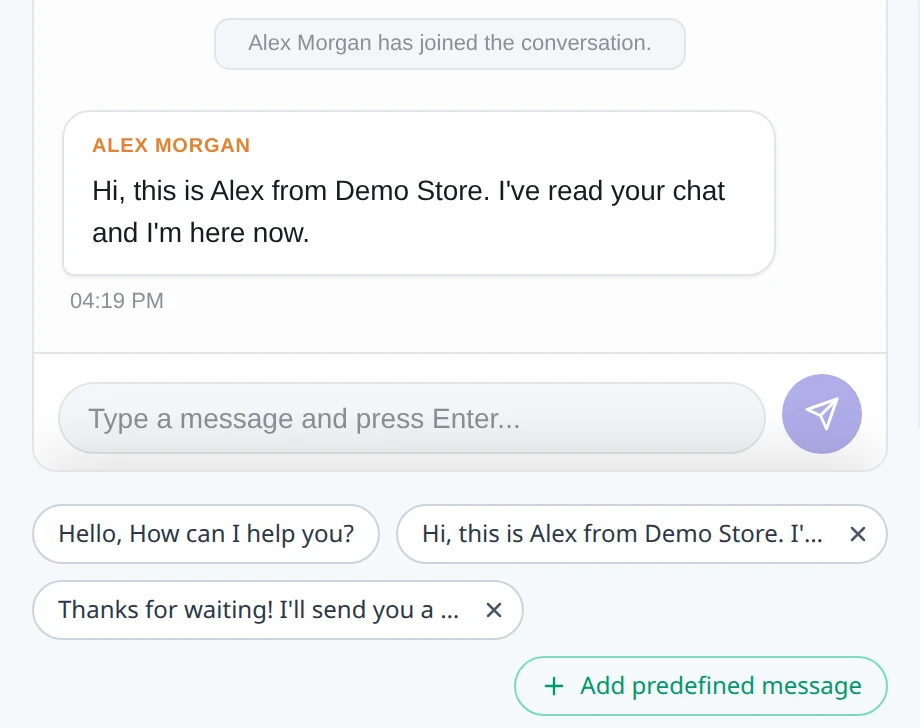
04:19 PM, the team’s view: one click to take over
Outside working hours, which you set per day with a time zone, Ovebot no longer hands the chat to a person and shows your contact details instead. Visitors can leave their details as a lead.
A twice-monthly email report shows the share of conversations resolved by AI and the support hours saved. Our guide to AI to human handoff covers the handover in detail.
What response time should a small store aim for?
Our view, since we found no neutral benchmark for chat or email in ecommerce:
| Channel | Target | How |
|---|---|---|
| Chat, first reply | Right away | Repeated questions answered by AI trained on your content |
| Chat, a person | Within minutes | During the working hours you publish |
| Same day | An acknowledgment with a date for the full answer | |
| After hours | A clear promise | Contact details and when you will reply |
Track your median first response time weekly and beat your own number. If chat is where your shoppers ask, Ovebot covers the instant answers, the handoff and the after-hours message in one widget. Compare the features, then start the 14-day free trial with no card required.
Frequently Asked Questions
What is the difference between first response time and average response time?
First response time is how long a shopper waits for the first reply in a conversation. Average response time covers every reply, including follow-ups. Report both as medians rather than means: a few very slow replies, such as emails left over a weekend, make the mean look worse than a typical shopper’s experience.
Does an automatic reply count as a first response?
Only if it helps. A message that answers the question, or says who will reply and when, gives the shopper a sense of progress. A generic “we received your message” says less. In the 2007 call study, callers told their place in line hung up far less often than callers who heard music or apologies.
How fast should I answer customer emails?
A 2003 study of hotel guests who complained by email found that satisfaction and intention to return were directly related to reply speed. Acknowledge each email the same business day, say when the full answer will come, and keep that promise.
Bottom line: answer fast, then say what happens next
Customer service response time is easiest to cut where questions repeat, so answer those instantly and route the rest to a person with a clear next step. Measure your own median first response time, and tell shoppers what happens while they wait.
Sources
- Mattila, A. S. and Mount, D. J. – The impact of selected customer characteristics and response time on e-complaint satisfaction and return intent – 2003 – https://pure.psu.edu/en/publications/the-impact-of-selected-customer-characteristics-and-response-time/
- Istanbulluoglu, D. (University of Birmingham) – Complaint handling on social media: the impact of multiple response times on consumer satisfaction – 2017 – https://research.birmingham.ac.uk/en/publications/complaint-handling-on-social-media-the-impact-of-multiple-respons/
- Harvard Business Review – The Short Life of Online Sales Leads – 2011 – https://hbr.org/2011/03/the-short-life-of-online-sales-leads
- Gnewuch, U. et al. (ECIS) – Faster Is Not Always Better: Understanding the Effect of Dynamic Response Delays in Human-Chatbot Interaction – 2018 – https://aisel.aisnet.org/ecis2018_rp/113/
- EUR-Lex – Directive (EU) 2015/2366 on payment services (PSD2), Article 101 – 2015 – https://eur-lex.europa.eu/eli/dir/2015/2366/oj
- UK Cabinet Office – Data on responses to correspondence from MPs and Peers in 2024 – 2024 data – https://www.gov.uk/government/publications/data-on-responses-to-correspondence-from-mps-and-peers-2024/data-on-responses-to-correspondence-from-mps-and-peers-in-2024-html
- Eurostat – E-commerce statistics for individuals – 2026 – https://ec.europa.eu/eurostat/statistics-explained/index.php?title=E-commerce_statistics_for_individuals
- Munichor, N. and Rafaeli, A. (Journal of Applied Psychology) – Numbers or apologies? Customer reactions to telephone waiting time fillers – 2007 – https://serveng.technion.ac.il/files/Lectures/Munichor-Rafaeli-JAP-TeleWaiting.pdf
- David Maister – The Psychology of Waiting Lines – 1985 – https://davidmaister.com/articles/1/52/
- Buell, R. W. and Norton, M. I. (Management Science) – The Labor Illusion: How Operational Transparency Increases Perceived Value – 2011 – https://ideas.repec.org/a/inm/ormnsc/v57y2011i9p1564-1579.html
This article was written with the help of artificial intelligence and reviewed by a human editor.