Small business customer service with no support team
Small business customer service for stores with no support team: one channel, written answers, AI for routine questions and a 30-minute weekly routine.

Small business customer service in a store run by one to five people works best as a small system, not as an owner on permanent standby. Write the answers down, pick one channel, publish your reply hours, let an AI chat handle routine questions and keep the judgment calls. Then spend 30 minutes a week closing the gaps.
Most EU businesses are small: micro and small enterprises (0-49 people) make up 99% of enterprises in the EU business economy, according to Eurostat’s final 2023 data.
Key Takeaways
- The questions repeat: delivery, order status, returns, guarantees and costs. Answer them once, on your site.
- Use one main channel and publish the hours a person reads it.
- Let AI answer from your written-down policies. Keep refunds outside policy, complaints and exceptions with you.
- Since August 2026, the EU AI Act requires your chat tool to tell customers they are talking to AI.
- A 30-minute weekly review of unanswered chats keeps the system improving.
What small business customer service means when you are the team
It means most questions get answered without you, and the rest reach you in one place, at a time you choose. In an owner-run store, support competes with packing, sourcing and marketing.
Large firms can staff a support desk and automate around it. Even among small firms with 10-49 staff, most don’t use AI yet. In the Eurostat 2025 survey, 55.03% of large enterprises used at least one AI technology, but only 17% of those small firms did. Firms under 10 people aren’t covered.
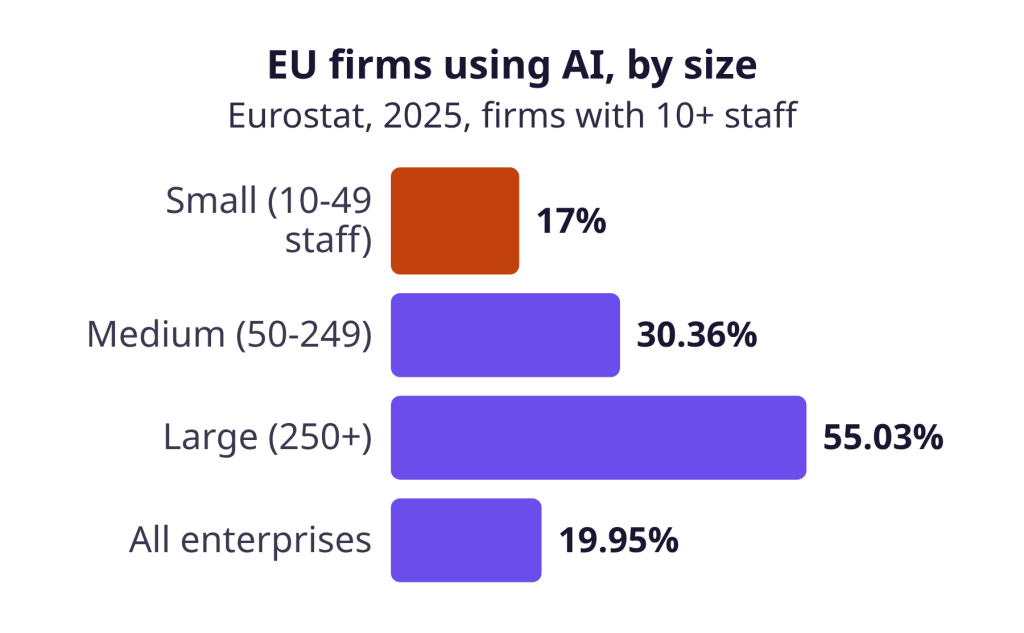
A small store can’t copy a large support desk. Customer service for a small team needs fewer, better-written answers, one main channel and clear limits, and a small store can set that up without hiring.
Choose one channel and publish your hours
Pick one main channel and say when a person reads it. One well-run channel beats five neglected ones. For most online stores that means chat on the site, with email for photos and documents. If shoppers write at night, 24/7 customer support without a night shift shows how to set the offline message and capture after-hours leads.
Being reachable matters most when shoppers don’t know you yet. A 2019 study in Information Systems Research found that human live chat on a Chinese marketplace raised the purchase probability for tablets by 15.99% (a relative increase). It mattered more for sellers with low feedback scores, which describes many new stores.
We found no neutral study of how fast shoppers expect a store to reply. The closest evidence is from freelance hiring, as reported by Cornell: a 1-hour reply delay lowered the odds of being hired by about 46%. The same study found that fast replies stopped helping when they seemed automated. That’s an analogy, not shopping data, but two lessons carry over. Published hours turn an unknown wait into an expected one. And a fast reply that reads as automated may not help, so make AI answers specific and the route to you easy.
Not every shopper will use a chatbot. In a Pew Research Center survey of US adults in February 2026, 51% said they never use AI chatbots, and use fell with age.
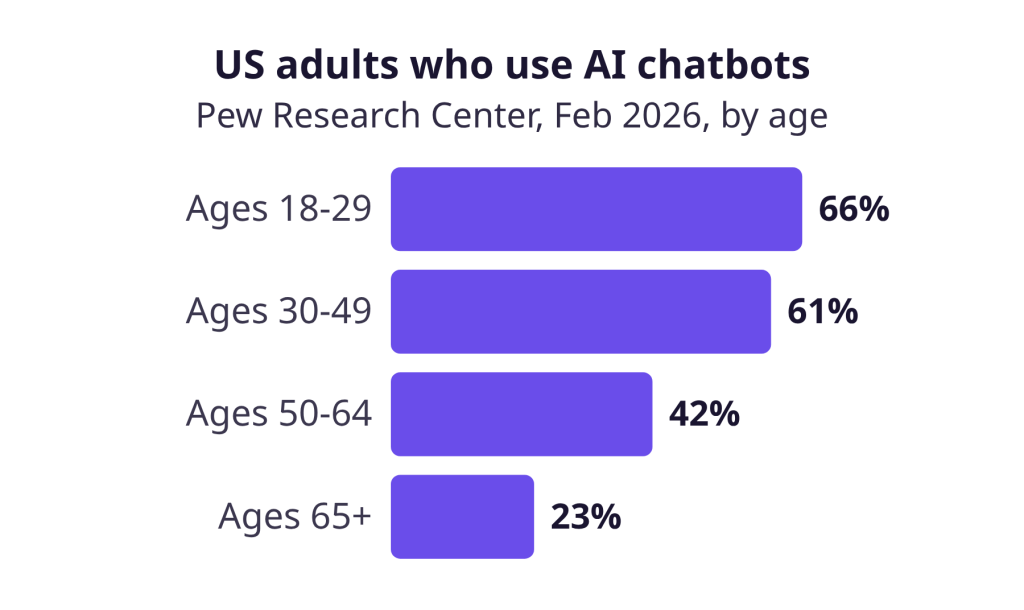
Among non-users, 79% worried about how their personal information is used. The survey covers chatbots in general, but the lesson carries over: keep your email visible and explain how chat data is handled. Our guide to GDPR and AI chatbots covers the privacy side.
Write down the answers shoppers need before they ask
Many support questions ask for information EU law already requires you to give before a sale. Written answers are the cheapest part of small business customer service: write them once and stop typing them in every chat.
According to Eurostat’s 2025 data, 78% of EU internet users aged 16-74 bought online in the previous 12 months, and 63% of e-shoppers reported no problem. The problems the rest reported show where your answers should go.
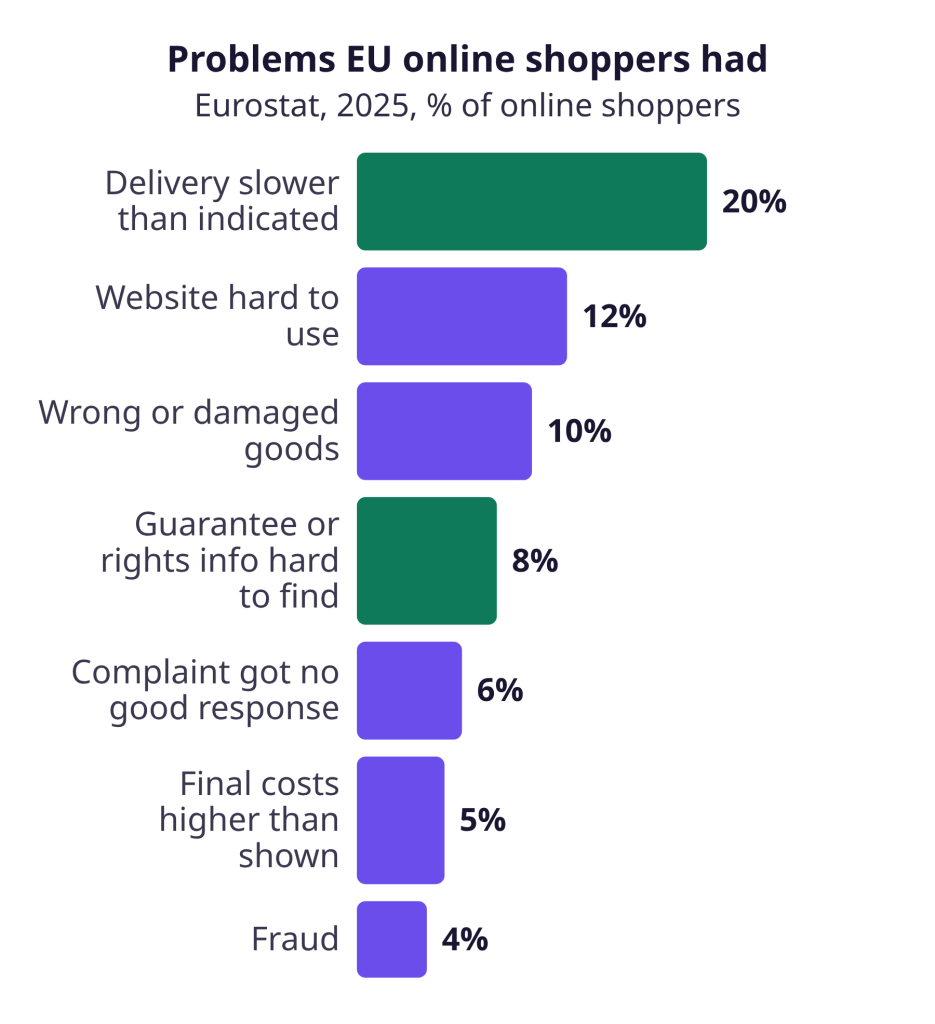
Slow delivery led at 20%, and 8% found it hard to find information on guarantees or legal rights. Written answers reduce both: realistic delivery times on the product page, and your guarantee and returns terms one click away.
Use the Your Europe guidance on distance selling as your checklist. Before the contract, shoppers must get:
- Your identity, physical and email address (phone if you have one)
- The total price, including taxes and delivery
- Payment methods
- Withdrawal conditions and form
- Complaint handling and guarantee conditions
Buyers can withdraw within 14 days without a reason, and goods carry a minimum 2-year legal guarantee. This is general information, not legal advice. A return policy template speeds up that page.
Also list what you don’t offer, such as gift wrapping. “No” is an answer shoppers can plan around.
What to hand to AI and what stays with you
Give AI the questions whose answers are written down or live in your systems. Keep anything that needs judgment, money outside your policy or an apology. That split is what makes support workable for one person.
| Hand to the AI chat | Keep with you |
|---|---|
| Delivery countries, costs and times | Refunds or discounts outside your policy |
| Order status and tracking | Complaints about damaged or wrong goods |
| Returns process, as written | Exceptions and custom orders |
| Product details and stock | Disputes and suspected fraud |
| Order change requests (collected) | Approving those changes |
For a three-tier version (automate, verify, hand over), see our guide to customer service automation.
An instant answer beats no answer, at least on one large platform. A 2025 working paper by Fang and colleagues tested a 24/7 pre-sale AI chatbot on one large cross-border retail platform and found conversion rose 21.7%. The control group was told customer service was unavailable, so it compares an AI answer with no answer, not AI with you.
The main risk is an AI that guesses. When the answer isn’t in your content, the chat should say so and offer a route to you. Our article on why AI chatbots give wrong answers explains what to check.
Be open about the bot: the AI Act’s transparency rules require it from August 2026.
A 30-minute weekly routine for small store support
A fixed weekly review keeps your answers improving without eating your week.
| Time | Task | Result |
|---|---|---|
| 10 min | Read chats the AI couldn’t answer or handed over | A list of missing answers |
| 5 min | Approve new facts, update FAQ or policy pages | The next shopper gets the answer |
| 5 min | Close open complaints and refunds; check no change request is still waiting | Nothing older than a week |
| 5 min | Update stock-outs, courier delays, holiday cutoffs | Fewer “where is it?” messages |
| 5 min | Ask the chat three real questions from last week | Proof the fixes work |
The first two rows matter most. Every gap you close is a question you rarely answer by hand again. Cancellations and address changes can’t wait for the weekly review: handle them the day they arrive, before the order ships.
How Ovebot runs this system for a small store
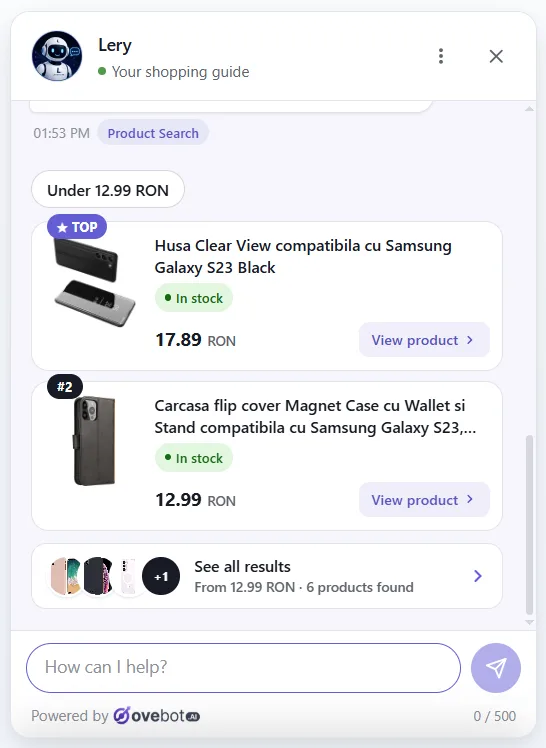
Ovebot runs this system inside your store’s chat widget. It answers from your own content, hands the chat to you during working hours, takes shoppers’ details after hours and proposes new facts for your approval.
Setup takes four steps:
- Install an official plugin for WordPress/WooCommerce, OpenCart, PrestaShop or Magento, or a one-line snippet elsewhere.
- Add your policy pages, PDFs or spreadsheets to the knowledge base.
- Connect your product feed.
- Set working hours per day, with your timezone.
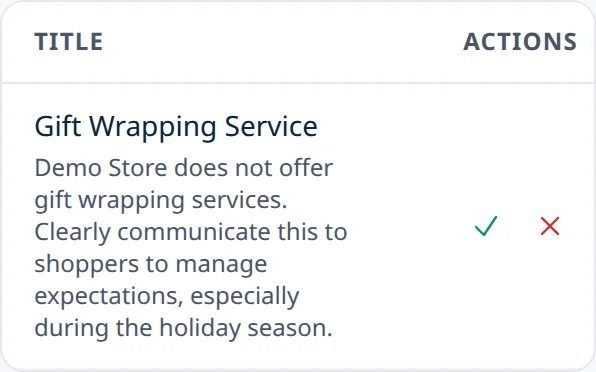
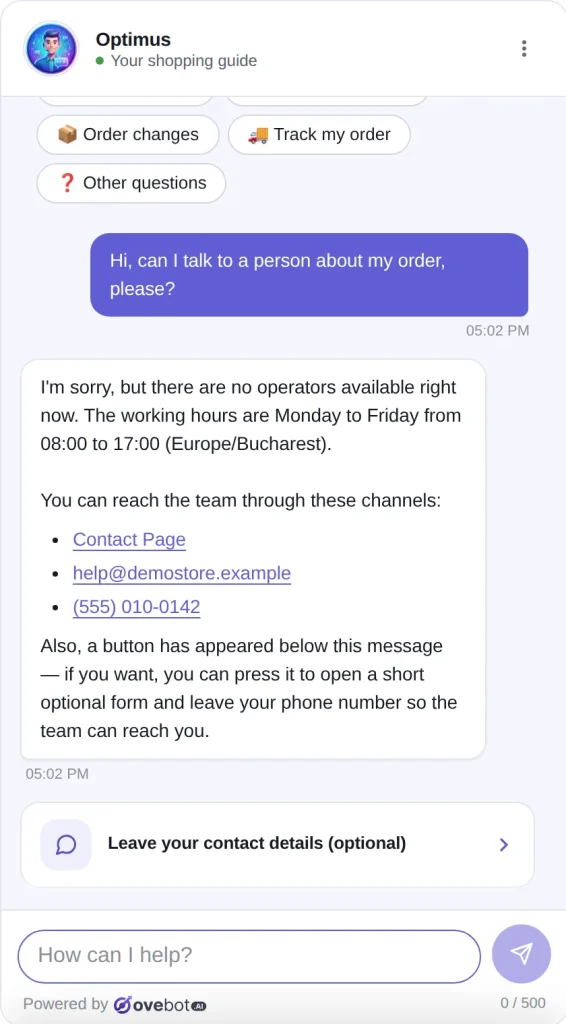
The screenshots show Ovebot on a demo store.
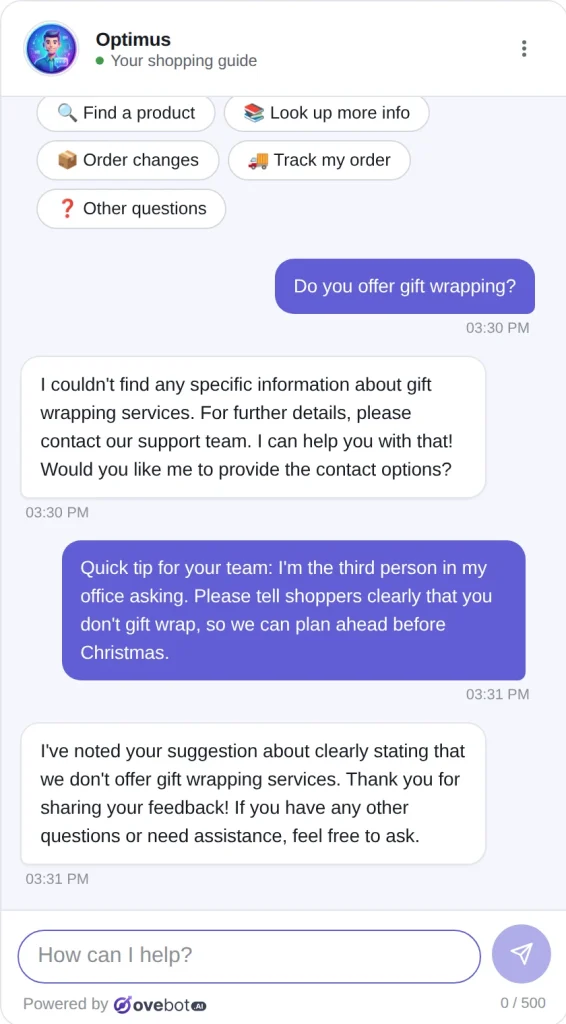
That suggestion becomes a proposal in the admin. You decide whether shoppers ever see it.
Inside your hours, the agent offers a person, and you take over with one click after a browser notification. Outside them, it shows your contact details instead.
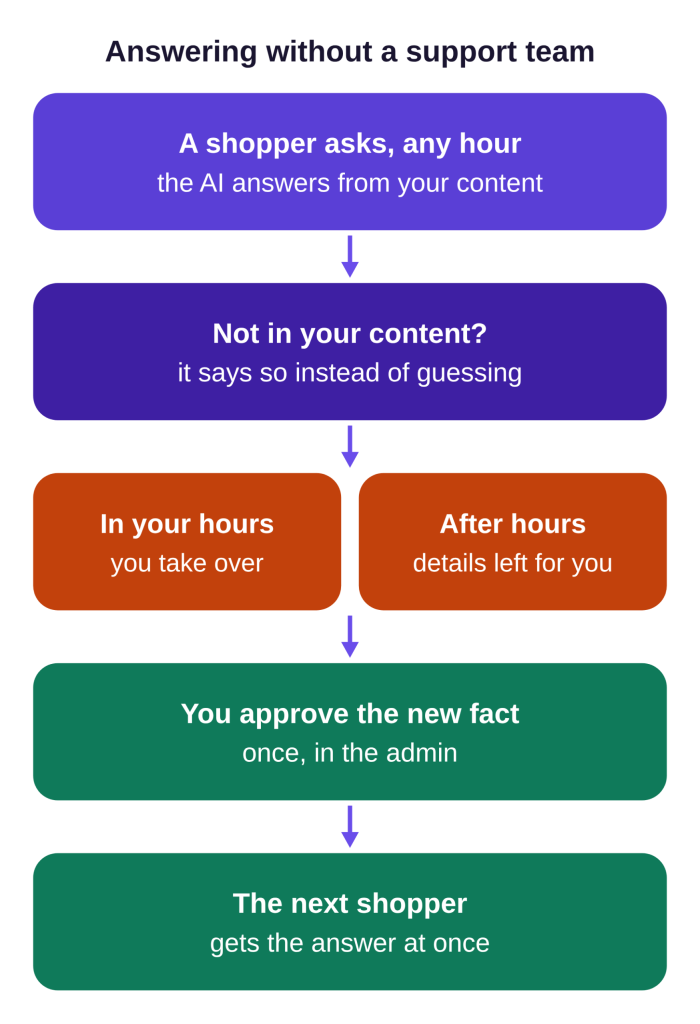
Two more jobs get lighter. Order-status questions are answered for you, and change requests reach you already verified. Shoppers check status live with their order number and checkout email or phone, once order tracking is connected to your store’s system. Cancellations or address changes are confirmed with a one-time email code before they reach you.
Why we recommend Ovebot for owner-run stores
For small business customer service without a support team, we recommend Ovebot because it covers the whole loop: answers, human handoff on your hours, after-hours lead capture and owner-approved memory. The features page lists them all.
Setup takes about 5 minutes without a developer, and the 14-day free trial needs no card. Data is stored in EU data centers, and the chat shows an AI disclosure and privacy notice when it opens, as the GDPR page explains.
Frequently Asked Questions
What should a small store write down first?
Start with what shoppers need before they buy: delivery countries, costs and times; the total price including taxes; how returns work, including the 14-day right of withdrawal; and your guarantee terms, with the 2-year legal minimum. Add what you don’t offer, such as gift wrapping or same-day dispatch. Put it on one page your chat can answer from, then link it from every product page.
Should a small online store use live chat or email?
Use both, with clear roles. Chat on the site catches questions while shoppers are deciding, and an AI chat can answer there when you’re busy. Email suits complaints, photos of damaged goods and documents. Keep the email address visible for shoppers who avoid chatbots: in a 2026 Pew survey of US adults about chatbots in general, 51% said they never use them.
What should an AI chatbot never handle alone in a small store?
Keep decisions that cost money or need empathy: refunds or discounts outside your policy, complaints about damaged goods, exceptions, disputes and suspected fraud. The chat can collect the details and pass them to you. It should never guess either. When the answer isn’t in your content, it should say so and offer a way to reach you.
Do I have to tell customers they are chatting with AI?
Yes, in the EU. The AI Act’s transparency rules apply from August 2026: people must be told when they interact with an AI system such as a chatbot, unless it is obvious. In practice, your chat tool must tell customers they are talking to AI, ideally when the chat opens. This is general information, not legal advice.
Bottom line: a small system beats being always on
Good small business customer service doesn’t need a support team, only answers written once and a clear route to you for everything else.
Sources
- Eurostat, EU businesses: EUR 10.5 trillion in value added in 2023, 2025
- Eurostat, Use of artificial intelligence in enterprises, data extracted December 2025
- Eurostat, E-commerce statistics for individuals, data extracted February 2026
- Pew Research Center, Why don’t people use chatbots?, 2026
- Fang, Yuan, Zhang, Donati and Sarvary, Generative AI and Sales Productivity: Field Experiments in Online Retail, working paper, 2025
- Tan, Wang and Tan, Impact of Live Chat on Purchase in Electronic Markets, Information Systems Research, 2019
- Cornell SC Johnson College of Business, press release on “Speed Is a Signal” (Hart, VanEpps, Amir and Sezer, Management Science), 2026
- Your Europe, E-commerce, distance and off-premises selling, accessed 2026
- Your Europe, Consumer guarantees, accessed 2026
- European Commission, AI Act, accessed 2026
This article was written with the help of artificial intelligence and reviewed by a human editor.