How to Increase Average Order Value with AI Chat
How to increase average order value with AI chat: what the research shows, five steps chat can deliver, targets to track and a demo store walkthrough.


To increase average order value with AI, use the chat to deliver a few deliberate levers at the right moment: the better-fit product, a matching accessory, a clearly explained add-on and an honest free-shipping threshold. A chatbot on its own mainly helps more visitors buy. It does not, by itself, make each cart bigger.
In a randomized 2023 experiment with 44,614 shoppers, Fang et al. found that an AI pre-sale chatbot raised conversion and sales per consumer, while cart value did not change significantly. So the order has to grow on purpose, one step of the session at a time.
Key Takeaways
- +21.7% conversion, -4.5% cart value (not significant): an AI pre-sale chatbot grew sales by converting more shoppers, not by filling bigger carts (Fang et al., 2023 test).
- 1% to 5%: the direct revenue lift that field tests of recommender systems most often report (Jannach and Jugovac, 2019).
- About 30% vs 3%: of shoppers who stopped at a 6-jam table, about 30% bought, against 3% at a 24-jam table (Iyengar and Lepper, 2000).
- Recommend the better-fit product, one compatible accessory and a clearly explained add-on or shipping threshold, with 1 to 3 suggestions per reply (our advice).
- Track AOV as Purchase revenue divided by Ecommerce purchases, always next to conversion rate and returns.
One shopping session, on a clock
An order grows in small steps inside one session, and chat can help at most of them. Here is one example session for a shopper buying an office laptop. The times are illustrative; the evidence at each stop is not.
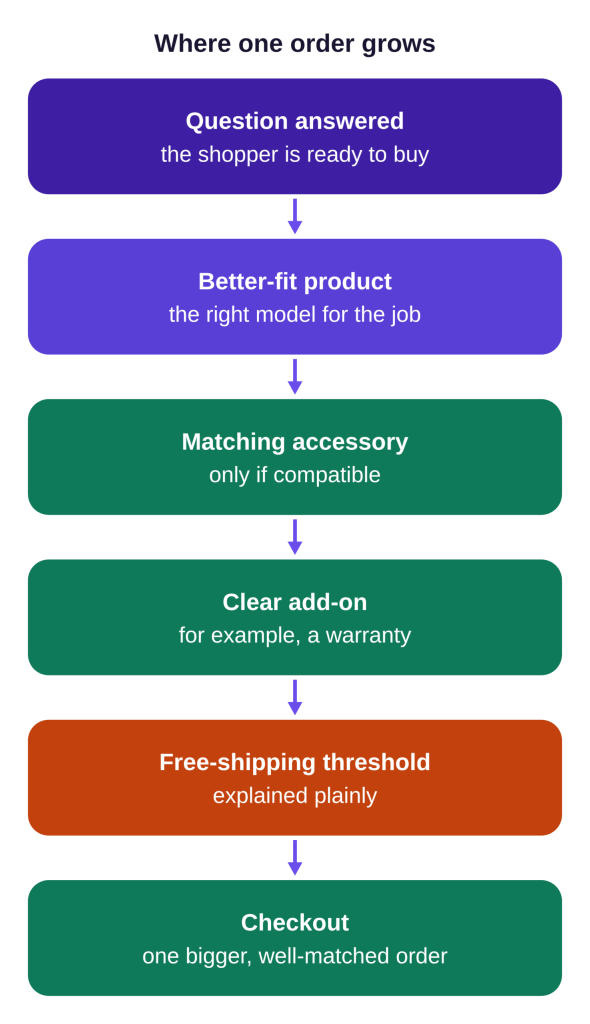
0:00: a shopper lands on a laptop page
The page lists specs but doesn’t say whether the laptop suits office work. In a 2021 study, Sun, Chen and Fan looked at live chat on a large online marketplace. Chat raised the share of traffic that turned into sales. The effect was stronger when product pages said less.
0:40: the first question
The shopper asks, and a useful answer makes a purchase more likely. In the Fang et al. experiment on a cross-border ecommerce platform, the chatbot group converted 21.7% more often. It also spent 16.3% more per consumer. Cart value moved by -4.5%, which was not statistically significant:
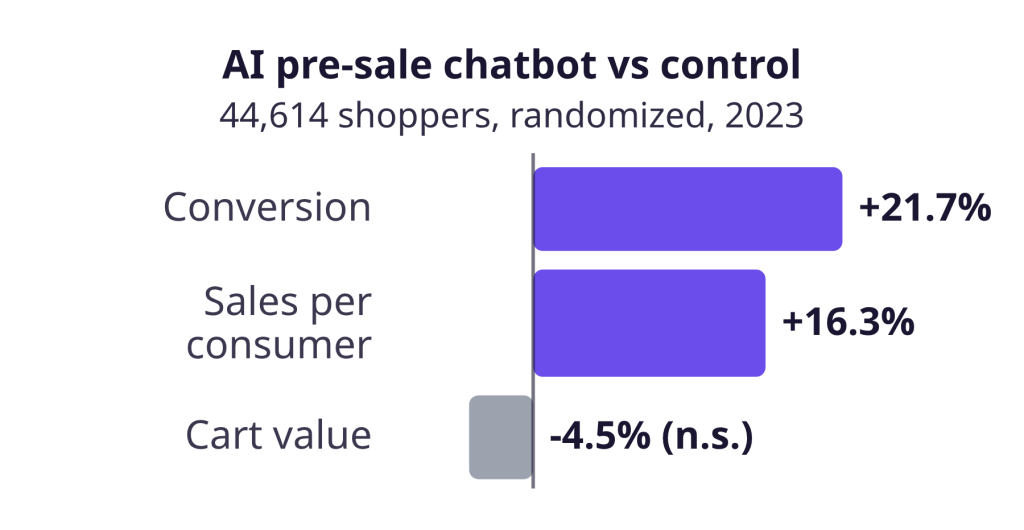
The control group got a “service unavailable” auto-reply, not a human. Across the paper’s seven experiments, the authors found that the extra sales came
…mainly from conversion rather than cart value. Fang, Yuan, Zhang, Donati and Sarvary, Generative Artificial Intelligence and Sales Productivity: Field Experiments in Online Retail, Management Science, 2026
1:30: the better-fit product
The shopper describes the work, and a recommendation narrows the list. In a randomized field experiment with 184,375 users at a top North American retailer, Lee and Hosanagar (2021) found that a recommender lifted every purchase stage:
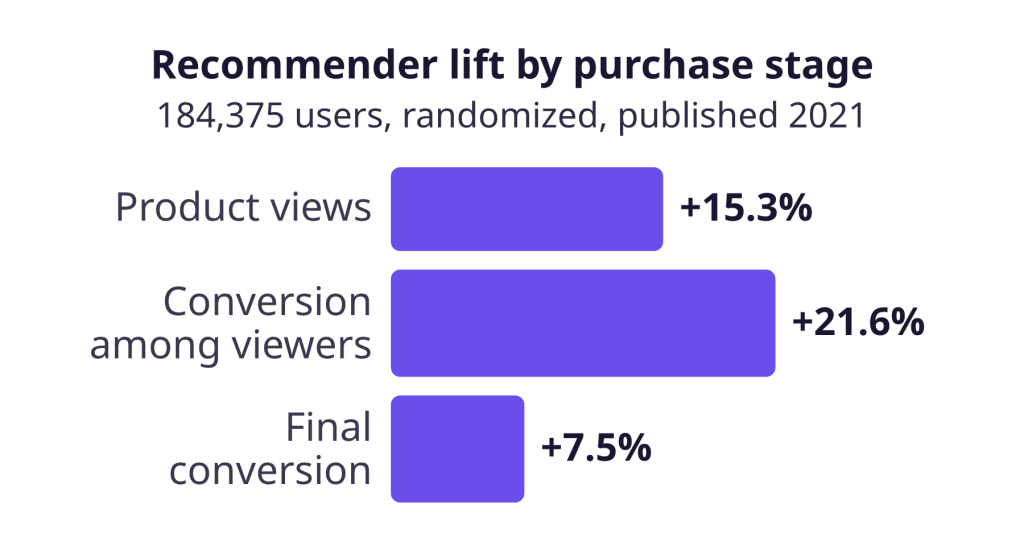
That study measured conversion, not order size. On revenue, a 2019 review of field tests by Jannach and Jugovac found direct increases “more often reported to lie between one and five percent”.
2:00: the matching accessory
Accessories give the cart its second line. Oestreicher-Singer and Sundararajan tracked more than 250,000 books at a large online bookstore for a year (2012 study). Visible “bought together” links made related products lift each other’s demand up to three times more on average.
2:30: the shipping line
The shopper checks delivery cost, and the threshold can tip the order either way. Lewis, Singh and Fay (2006) found consumers “very sensitive to shipping charges”: fees changed both whether people ordered and how much they bought. Our guide to cart abandonment covers the same cost surprise from the exit side.
3:00: checkout
At checkout, the order value is fixed. AOV is revenue divided by the number of orders. The measurement section below shows how to read it in Google Analytics 4.
How to increase average order value in 5 steps
Each step adds value only when it helps the shopper buy the right thing, and chat delivers it at the moment the question comes up.
1. Recommend the better fit, not the most expensive
Ask what the product is for, then recommend the model that fits that use. Sometimes that is the higher-spec model and sometimes the cheaper one. A shopper who trusts the first pick is more likely to listen to the next suggestion. Our guide to the AI shopping assistant shows how these conversations run.
What it does: the shopper buys a product they will keep, the base the rest of the order builds on.
2. Suggest the accessory that matches the cart
Offer complements, parts and consumables for the item already chosen: a dock for a laptop, toner for a printer, filters for a coffee machine. Check compatibility first. A wrong accessory turns into a return and costs trust in every later recommendation, so “we have no confirmed compatible model” is the better answer when the catalog has none. A bundle works the same way: a set of items you have already matched, offered as one choice.
What it does: adds a second line the shopper actually needs.
3. Explain add-ons from your own content
Write the terms of each add-on, such as an extended warranty, in your store content: how long it lasts, which products qualify and what it costs. The chat can then answer from those facts instead of guessing. Our guide to the ecommerce knowledge base shows how to write such entries.
What it does: turns a vague “maybe” into an informed yes or no.
4. Set a free-shipping threshold and explain it plainly
Free shipping above a threshold brings extra sales but can be unprofitable, Lewis et al. found. The threshold also changes how the offer feels. In a 2012 study by Koukova, Srivastava and Steul-Fischer, shoppers below the threshold liked it less than a flat fee. Shoppers above it liked it more. Explaining the fee as a delivery cost helped.
Watch returns as well. Shehu, Papies and Neslin (2020) found that free-shipping promotions raised net sales but shifted spending to riskier items. At the retailer studied, net order volume rose 7.4% while profit fell 0.7%, as Tuck School of Business reported. Without the extra returns, profit would have risen 3.3%.
What it does: shows the shopper how close they are to free delivery and why the fee exists.
5. Keep it to 1 to 3 suggestions
Fewer options can sell more. In the 2000 jam study by Iyengar and Lepper, a table of 24 jams stopped more passers-by. But among the shoppers who stopped, the table of 6 turned far more into buyers:
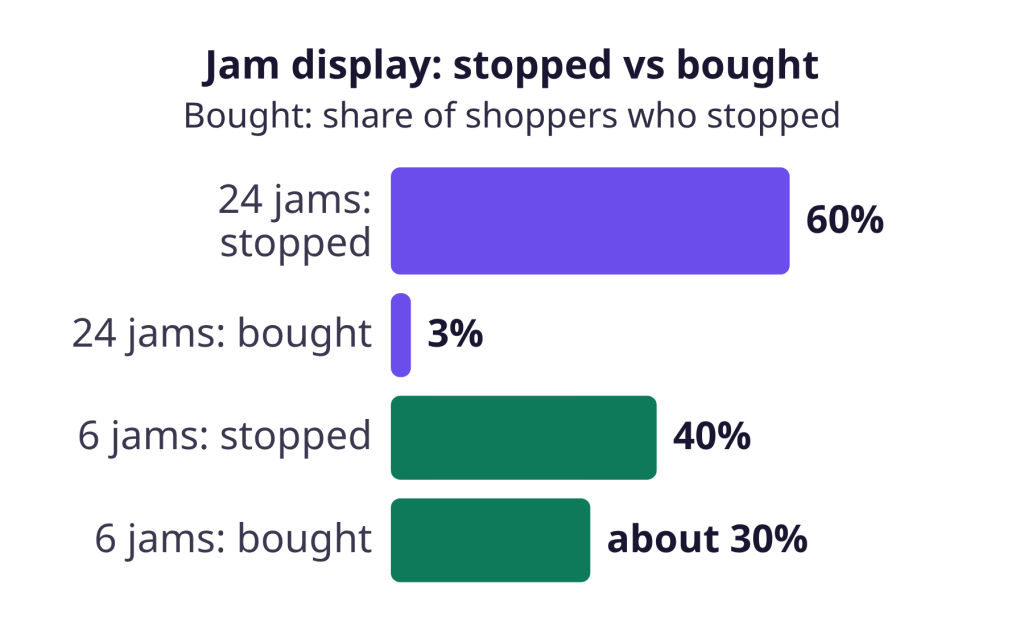
Replications have been mixed. A 2015 meta-analysis by Chernev, Böckenholt and Goodman found that choice overload depends on option complexity, task difficulty, preference uncertainty and a wish to minimize effort. It gives no ideal number, so “1 to 3 suggestions per reply” is our own advice.
| Moment | Helpful wording | Pushy wording |
|---|---|---|
| Product pick | “For office multitasking, the 16 GB model fits better.” | “Most people upgrade to our top model!” |
| Accessory | “This dock is listed as compatible with your laptop.” | “You’ll also need these six accessories.” |
| Warranty | “Here is what the extension covers and what it costs.” | “Don’t risk it, add protection now!” |
| Shipping | “This filter pack fits your machine and brings the order over the free-delivery threshold.” | “Spend more to unlock free shipping!” |
What it does: keeps the decision easy, so an extra item doesn’t stall the purchase.
How it works in Ovebot: one afternoon on a demo store
Ovebot handles the fit, the accessory check and the add-on answer in the store’s chat widget, working from the store’s own content and live product catalog. These four screens come from one afternoon on a demo store.
3:33 PM: the better-fit laptop
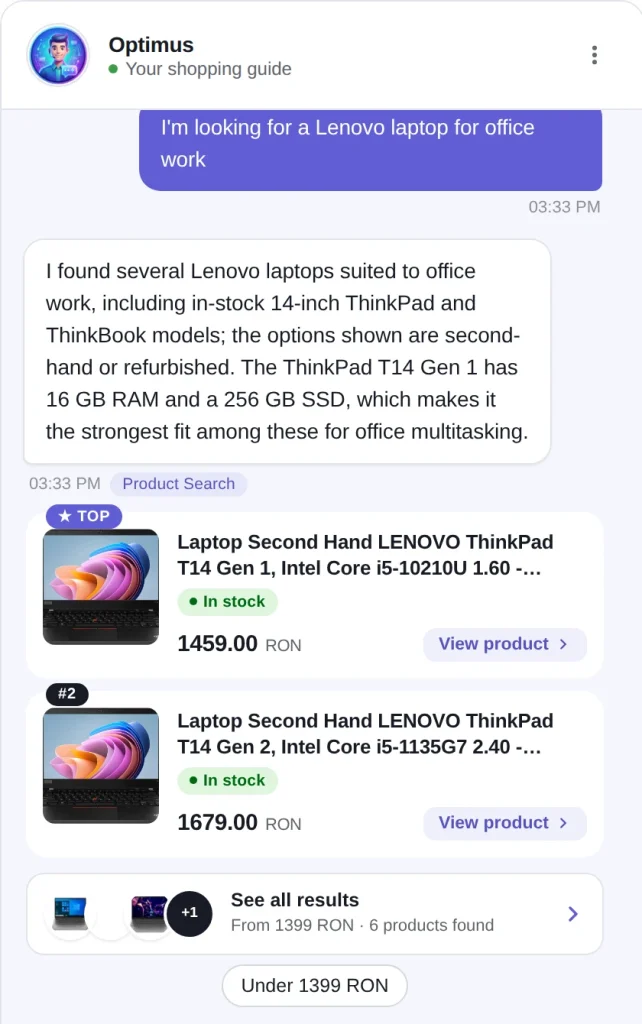
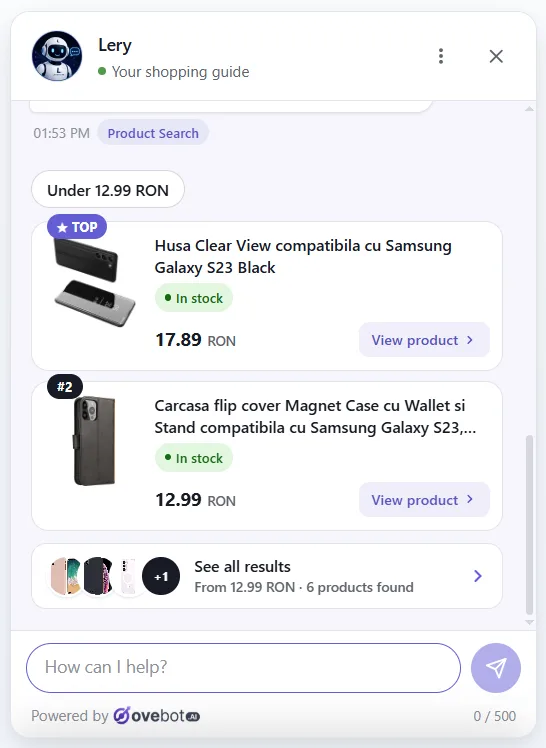
The reply named the ThinkPad T14 Gen 1, with 16 GB RAM, as the strongest fit for office multitasking. It is also cheaper than the second card, the T14 Gen 2 with 8 GB. The Product Search label shows that the reply came from the live catalog. Prices appear in RON because the demo catalog belongs to a European store.
3:35 PM: no compatible dock, so no dock
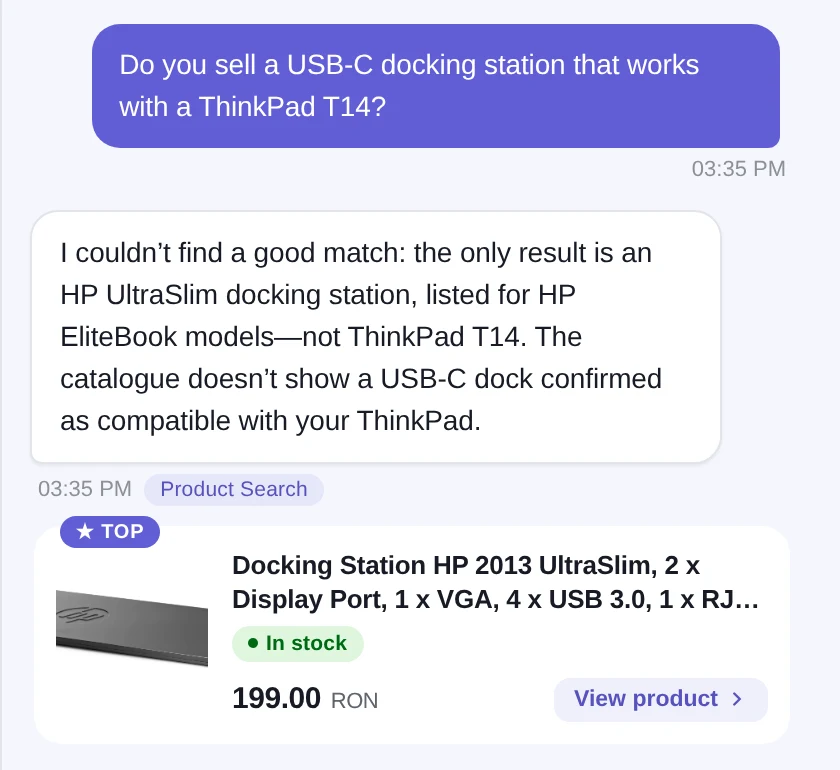
The catalog’s only dock was listed for HP EliteBook models, and the reply said so instead of forcing an upsell. The shopper can trust the next suggestion.
3:36 PM: the warranty question
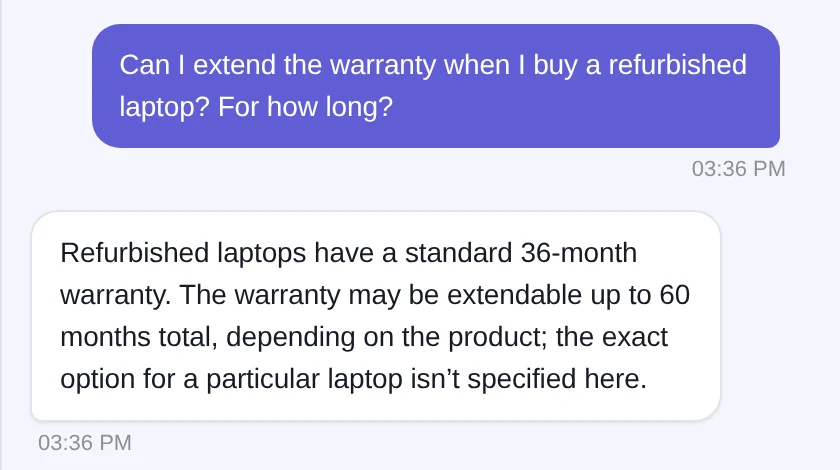
The reply gave the standard 36 months and a possible extension up to 60, depending on the product. Where the store’s content stopped, the reply stopped too, which shows the owner which entry to add next.
Same afternoon: add to cart from the chat
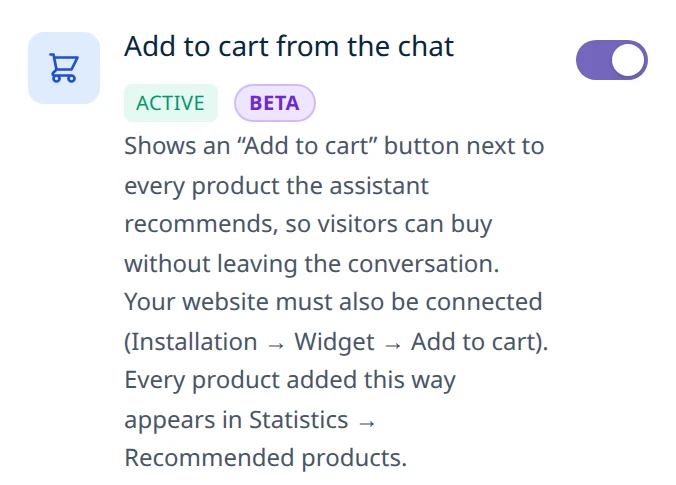
The widget screens above show View product buttons. This setting, still marked beta, works once the website is connected. It adds an Add to cart button next to every recommended product, and each product added that way appears in Statistics under Recommended products. A Finish your order button then leads to checkout.
If you want chat that recommends real products with current stock and price, takes the cart into account for accessories and consumables, and admits a missing match as in the dock reply above, we recommend Ovebot. Compare the features, then connect your store through the official plugins or a one-line snippet; setup takes about 5 minutes, no developer needed. Every plan includes every feature, with a 14-day free trial without a card.
What to measure when you increase AOV
Measure AOV as Purchase revenue divided by Ecommerce purchases, always beside conversion and returns. In the Google Analytics 4 metrics reference, Purchase revenue is revenue from purchases minus refunds, and Ecommerce purchases counts completed purchases. Avoid Transactions as the divisor, because it also counts refund events.
AOV alone can rise while revenue per visitor falls: if pushy suggestions scare off some buyers, the remaining orders are bigger but fewer. In AOV ecommerce reporting, read the three together. Our guide to ecommerce conversion rate covers the other half.
| Lever | Target | How to measure |
|---|---|---|
| Average order value | Up against your own baseline, conversion flat or up | GA4: Purchase revenue / Ecommerce purchases, before and after launch |
| Revenue per visitor | Up | GA4: Purchase revenue divided by Sessions, same period |
| Fit-based recommendations | More recommended products clicked and added to cart | Chat analytics: products clicked, add-to-carts |
| Matching accessories | More orders with a second matching item | Order export: orders with two or more lines |
| Add-ons such as warranty | Higher attach rate on eligible products | Orders with the add-on / orders of eligible products |
| Free-shipping threshold | More orders just above it, returns stable | Order value spread and return rate, before and after |
| Chat-influenced orders | Orders and revenue that came through chat | Chat analytics with the order tracking snippet |
Frequently Asked Questions
Can an AI chatbot increase average order value by itself?
Not according to the best controlled evidence. In a randomized 2023 test, an AI pre-sale chatbot raised conversion by 21.7% and sales per consumer by 16.3%, while cart value did not change significantly. Order size grows when the chat delivers specific levers: the better-fit product, a compatible accessory, an explained add-on and a clear shipping threshold.
What is a good average order value?
A good AOV is one that rises against your own baseline without conversion or returns getting worse. It depends on your product mix and prices, so a laptop store and a tea shop can’t share a benchmark. Compare the same periods before and after a change, and read AOV next to revenue per visitor.
How many product suggestions should a chat show at once?
We suggest 1 to 3 per reply; that is our advice, not a research result. In the 2000 jam study, about 30% of shoppers who stopped at 6 jams bought, against 3% of those who stopped at 24. Later research found the effect depends on how complex the options are, so a few well-matched options are the safer default.
Should the chat tell shoppers it is AI?
Yes. Under the EU AI Act, people using chatbots must be made aware they are talking to a machine, and these transparency rules have applied since August 2026 (European Commission). In a 2019 study of outbound sales calls, Luo et al. found upfront disclosure cut purchase rates by more than 79.7%, so disclose and be useful. Ovebot shows an AI disclosure when the chat opens (GDPR details).
Bottom line
AI chat mainly helps more shoppers buy. To increase average order value, give it deliberate levers: the right fit, a compatible accessory, a clear add-on and an honest shipping threshold, with few suggestions and an honest “no” when nothing fits.
Sources
- Fang, Yuan, Zhang, Donati and Sarvary (Management Science) – Generative Artificial Intelligence and Sales Productivity: Field Experiments in Online Retail – 2026 – https://arxiv.org/abs/2510.12049
- Lee and Hosanagar (Management Science) – How Do Product Attributes and Reviews Moderate the Impact of Recommender Systems Through Purchase Stages? – 2021 – https://doi.org/10.1287/mnsc.2019.3546
- Jannach and Jugovac (ACM Transactions on Management Information Systems) – Measuring the Business Value of Recommender Systems – 2019 – https://doi.org/10.1145/3370082
- Oestreicher-Singer and Sundararajan (Management Science) – The Visible Hand? Demand Effects of Recommendation Networks in Electronic Markets – 2012 – https://doi.org/10.1287/mnsc.1120.1536
- Sun, Chen and Fan (Production and Operations Management) – Effect of Live Chat on Traffic-to-Sales Conversion: Evidence from an Online Marketplace – 2021 – https://doi.org/10.1111/poms.13320
- Lewis, Singh and Fay (Marketing Science) – An Empirical Study of the Impact of Nonlinear Shipping and Handling Fees on Purchase Incidence and Expenditure Decisions – 2006 – https://doi.org/10.1287/mksc.1050.0150
- Koukova, Srivastava and Steul-Fischer (Journal of the Academy of Marketing Science) – The Effect of Shipping Fee Structure on Consumers’ Online Evaluations and Choice – 2012 – https://doi.org/10.1007/s11747-011-0281-2
- Shehu, Papies and Neslin (Journal of Marketing Research) – Free Shipping Promotions and Product Returns – 2020 – https://doi.org/10.1177/0022243720921812
- Tuck School of Business – The High Cost of Free Shipping – 2018 – https://tuck.dartmouth.edu/news/articles/the-high-cost-of-free-shipping
- Iyengar and Lepper (Journal of Personality and Social Psychology) – When Choice Is Demotivating: Can One Desire Too Much of a Good Thing? – 2000 – https://doi.org/10.1037/0022-3514.79.6.995
- Chernev, Böckenholt and Goodman (Journal of Consumer Psychology) – Choice overload: A conceptual review and meta-analysis – 2015 – https://doi.org/10.1016/j.jcps.2014.08.002
- Luo, Tong, Fang and Qu (Marketing Science) – Machines vs. Humans: The Impact of Artificial Intelligence Chatbot Disclosure on Customer Purchases – 2019 – https://doi.org/10.1287/mksc.2019.1192
- Google for Developers – Google Analytics Data API: API dimensions and metrics – current page – https://developers.google.com/analytics/devguides/reporting/data/v1/api-schema
- European Commission – Regulatory framework on AI (AI Act) – current page – https://digital-strategy.ec.europa.eu/en/policies/regulatory-framework-ai
This article was written with the help of artificial intelligence and reviewed by a human editor.