Multilingual customer support for cross-border stores
Multilingual customer support for EU stores: set language tiers, write policies once, let AI chat reply in each language, keep a person for hard cases.

Multilingual customer support means a shopper can ask a question and get a correct answer in their own language. A small store doesn’t need native speakers for every market to offer it. Decide which languages get which level of service, write your policies once, let an AI chatbot answer from them in the shopper’s language, and keep a person for the hard cases.
Key Takeaways
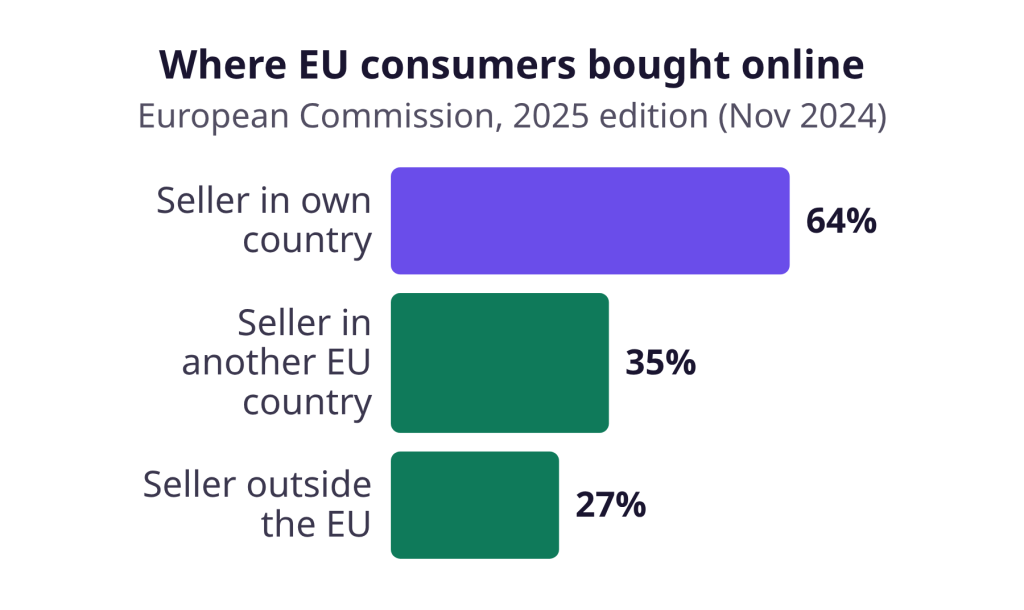
- 35% of EU consumers bought online from a retailer in another EU country, up 7 points since 2022 (European Commission, 2025).
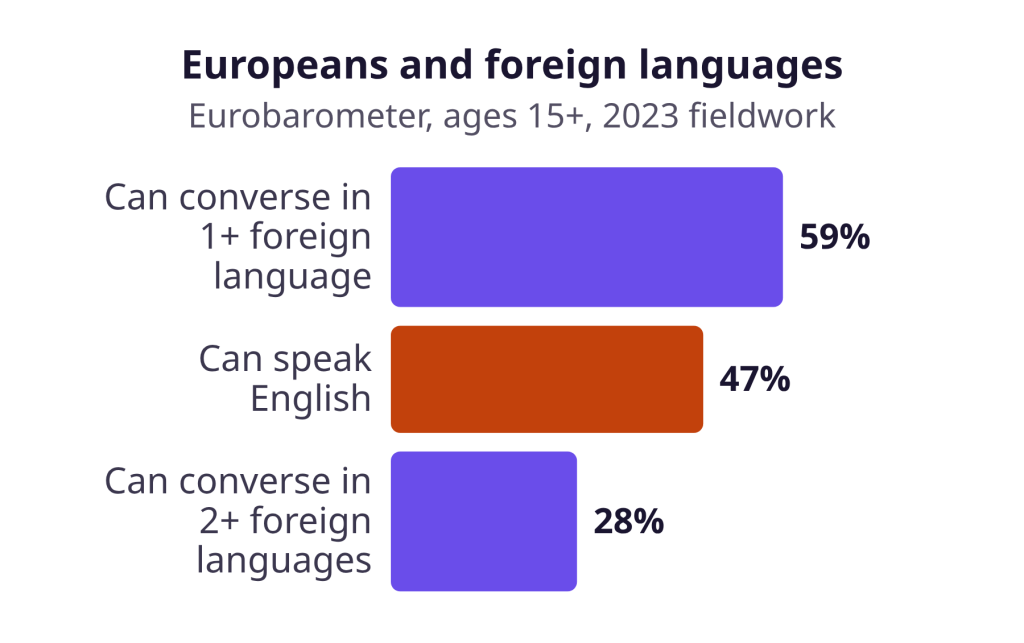
- 59% of Europeans can hold a conversation in a foreign language, so about 4 in 10 can’t. Only 47% speak English (Eurobarometer, 2024).
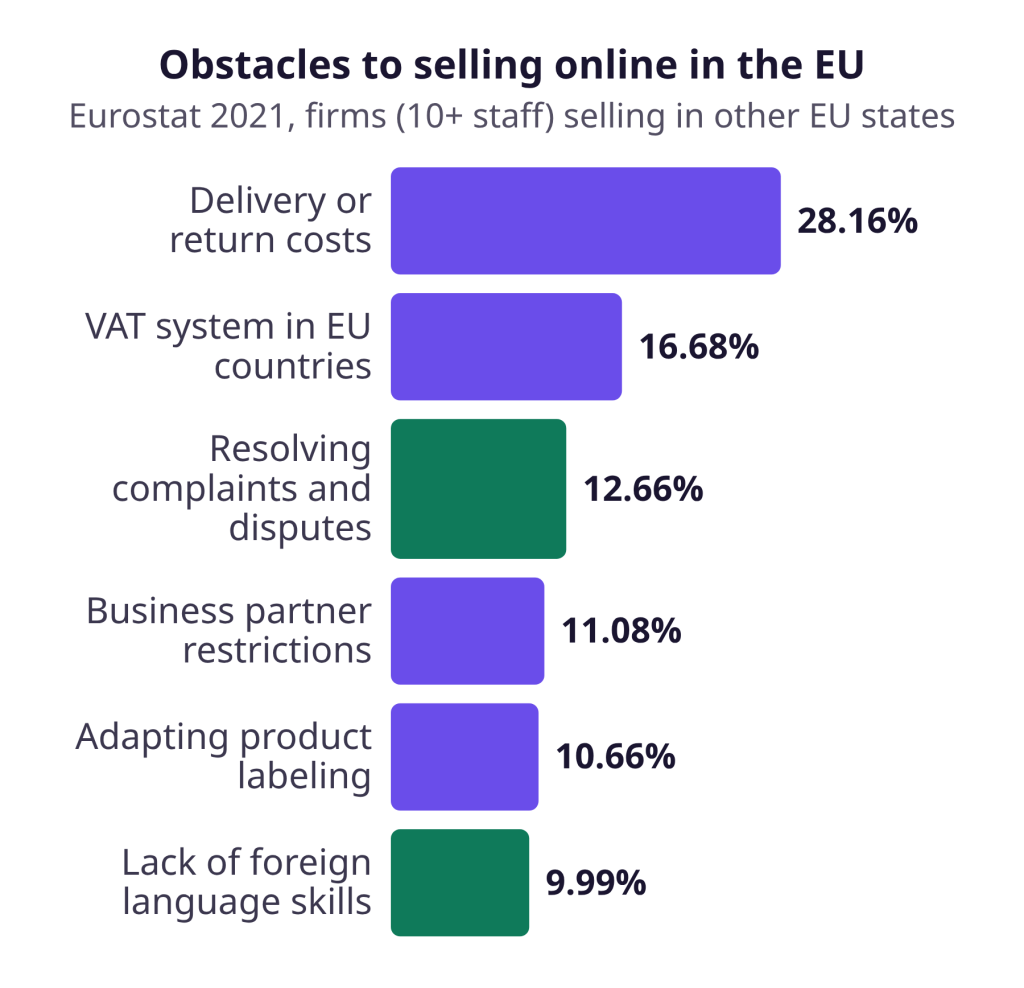
- Among EU businesses (10+ employees) that sell online to other EU countries, language is the least-cited obstacle: 9.99%, behind delivery costs, VAT and complaints (Eurostat, 2021).
- Sort your languages into three tiers, write policies once and let a chatbot answer from them in the shopper’s language.
- Keep a person for complaints and returns, and say which languages your team reads.
Cross-border ecommerce is now ordinary shopping. In the European Commission’s Consumer Conditions Survey, 2025 edition, 64% of consumers had bought online from a seller in their own country in the past 12 months. In the same period, 35% had bought from a retailer in another EU country and 27% from one outside the EU, each up 7 points since 2022.
Why language matters to shoppers
Most shoppers prefer to buy in their own language, and many can’t fall back on English. The EU has 24 official languages. In Special Eurobarometer 540, published in 2024, 59% of Europeans said they can have a conversation in at least one foreign language. Only 28% manage two, and 47% speak English. Put another way, about 4 in 10 can’t hold a conversation in any foreign language, and about half don’t speak English.
Older surveys show the same preference at the point of purchase. In a 2011 Eurobarometer survey of EU internet users, 90% preferred websites in their own language, and 42% said they never buy online in another language. In 2020, the language-industry research firm CSA Research surveyed 8,709 consumers in 29 countries worldwide. In that survey, 76% preferred to buy products with information in their native language, and 40% said they will never buy from websites in other languages.
Both studies are about website and product information, not support. None of our sources measures how multilingual customer support changes sales, so treat these numbers as a signal of preference, not a forecast.
Where language matters most: complaints and returns
Our view: language matters most when something goes wrong. A product question survives a rough translation, but a complaint or a return from abroad needs every detail understood. No survey measures this directly. What the data does show: sellers rarely name language as an obstacle, yet problems are common and most complaints go to the store first.
Eurostat asked EU enterprises with 10 or more employees and web sales to other EU countries about obstacles. In 2021, the latest year with EU-wide data, 28.16% cited the high cost of delivering or returning products, followed by the VAT system. Resolving complaints and disputes was named by 12.66%. Lack of foreign language skills came last at 9.99%, about 1 in 10. More than half, 56.06%, reported none of the listed difficulties.
Problems are common enough to plan for. In the Commission survey, 26% of people who bought online in the past 12 months experienced a problem. Of those who took action, 85% complained to the retailer or service provider. Eurostat adds that 6% of e-shoppers found complaints and redress difficult or got no satisfactory response.
What EU law does and does not require
EU law doesn’t require customer service in every shopper’s language. Member states can set their own language rules for contract information, so check each country you target. Three points apply across the EU:
- Online buyers can cancel within 14 days without giving a reason.
- A store can’t redirect a shopper automatically to another country version without permission.
- The geo-blocking rules don’t require you to deliver everywhere or translate your site.
This is not legal advice.
How to set up multilingual customer support in five steps
Most of the work is in Step 3, writing clear policies once. The other four steps are short.
Step 1: List the countries and languages you already serve
Check your analytics, order addresses and support inbox for the past few months. Count orders and questions per language. Start from real demand, not from a list of markets you hope to enter.
Step 2: Sort the languages into tiers
Each tier gets a different level of service, and shoppers should know which one they are in.
| Tier | Languages | What you offer |
|---|---|---|
| 1 | Your home language and any language a team member speaks well | Full support with a person who speaks it |
| 2 | Languages with regular orders | AI chat in the language, plus a human reply in English or your language |
| 3 | Languages with occasional orders | AI chat only, stated clearly on your contact page |
Step 3: Write the policies shoppers ask about, once
Cover delivery countries, costs and times per country, returns from abroad, warranty and payment methods. Short sentences translate better. A return policy template saves time here. If you translate the site itself, Google recommends separate URLs for each language version and advises against automatic redirects between them.
Step 4: Switch on a multilingual chatbot and test it
The chatbot should answer from the policies you wrote in Step 3, in the shopper’s language. An ecommerce chatbot trained on your own content does this without a script per language. With Ovebot, you install an official plugin and add your policy pages to the knowledge base. Then ask the same five questions in every language you sell in:
- Do you deliver to my country, and what does it cost?
- How long does delivery take?
- How do I return an order from abroad, and who pays for shipping?
- What warranty do your products have?
- Which payment methods can I use?
Check that the numbers match your policy in each language. For smaller languages, ask a native speaker to read a sample. A 2023 study compared translation quality across 204 languages and found that the large language models it evaluated trailed traditional machine translation for 84.1% of them. The amount of training material available for a language mattered most. The study covers 2023 models, not today’s, but the lesson holds: test the languages you actually sell in.
Step 5: Decide what happens when a person is needed
Offer a handoff to a person during working hours and show contact details outside them. Tell shoppers which languages your team reads, so nobody waits for a reply that can’t come.
If a complaint arrives in a language nobody on the team reads, reply in English with a machine-translated copy, and say that it is a translation. Keep order numbers and amounts as digits, and write dates with the month spelled out (March 4, 2026), so nothing gets lost.
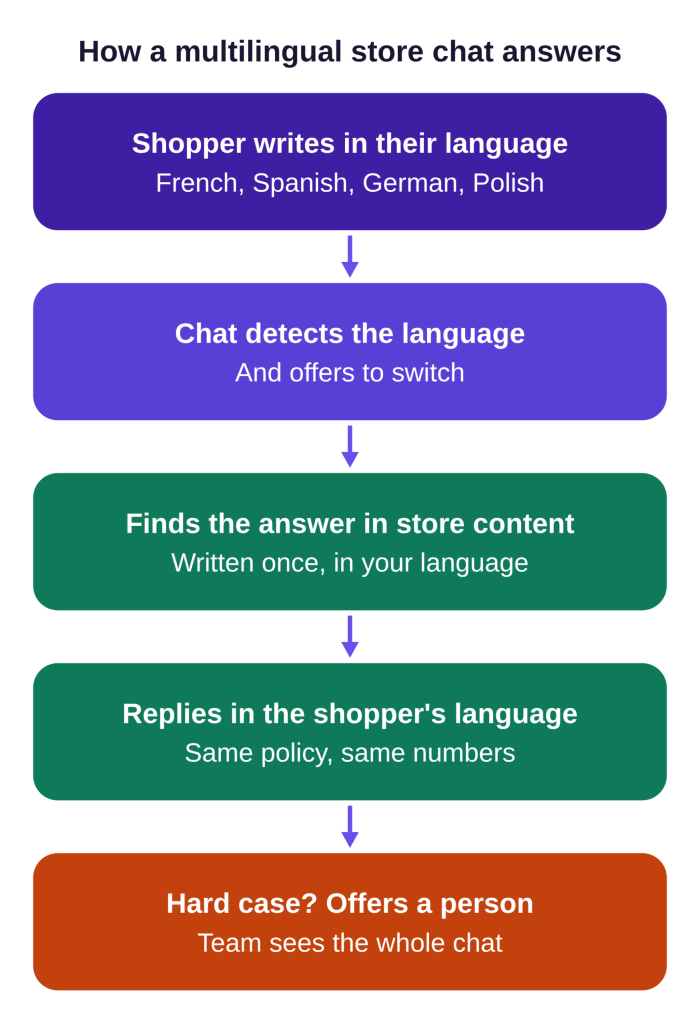
The whole flow, in one picture:
How it works in Ovebot
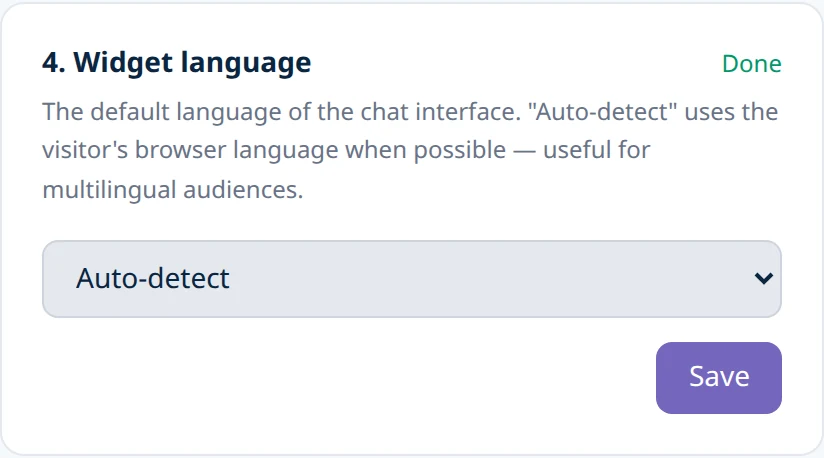
Ovebot answers in 29+ languages from your store’s knowledge base and live product catalog. It detects the visitor’s language, translates the welcome message automatically and can switch languages mid-chat. In the setup wizard, the widget language is one setting.
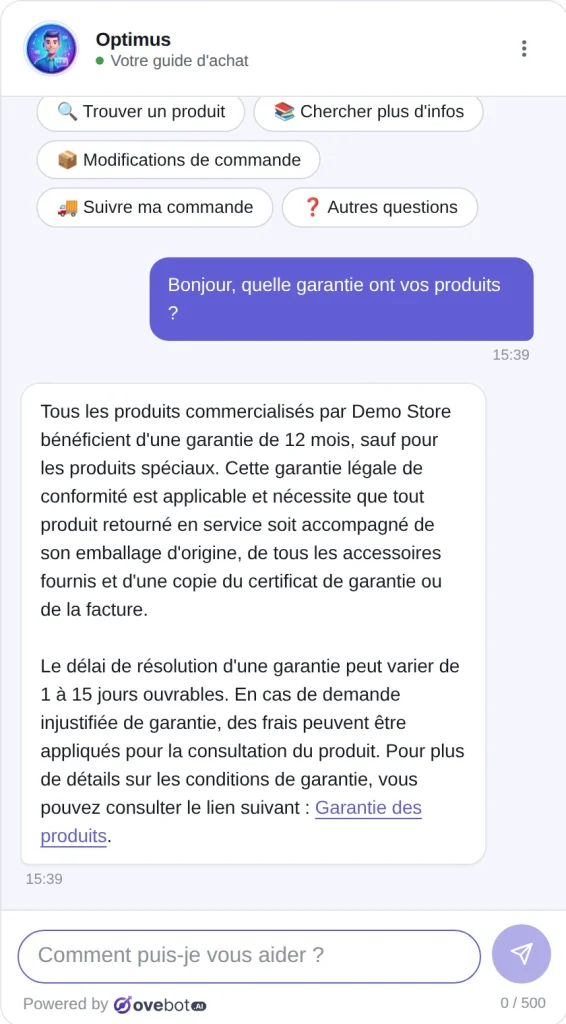
The screenshots show Ovebot on a demo store; figures come from the sources listed at the end.
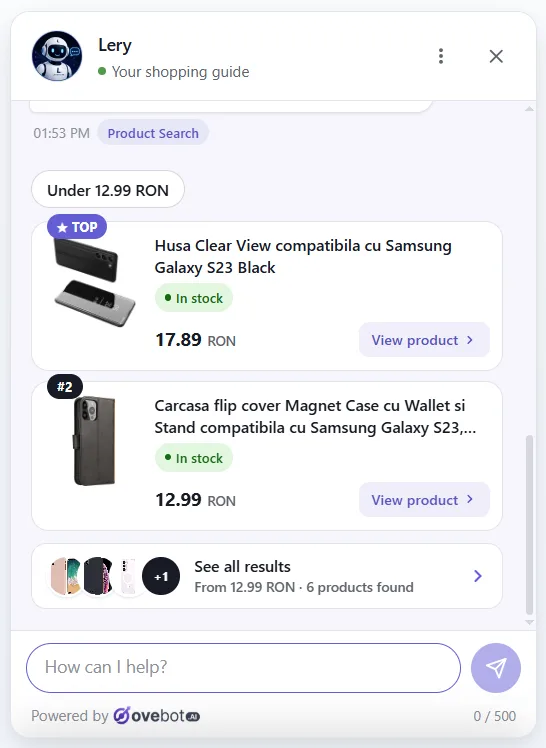
On our demo store, a French-speaking shopper sees the widget in French and gets the store’s warranty terms in French.
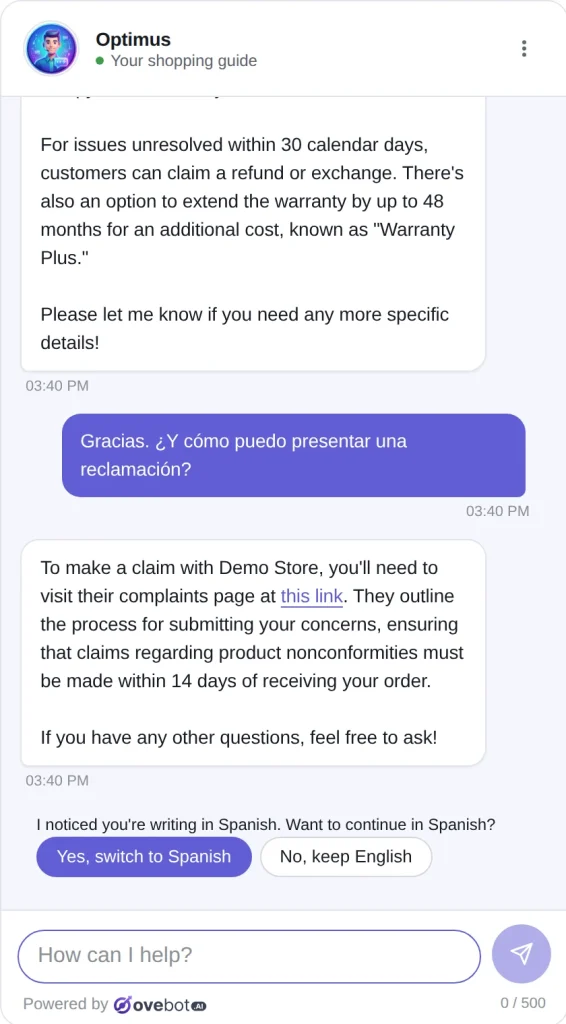
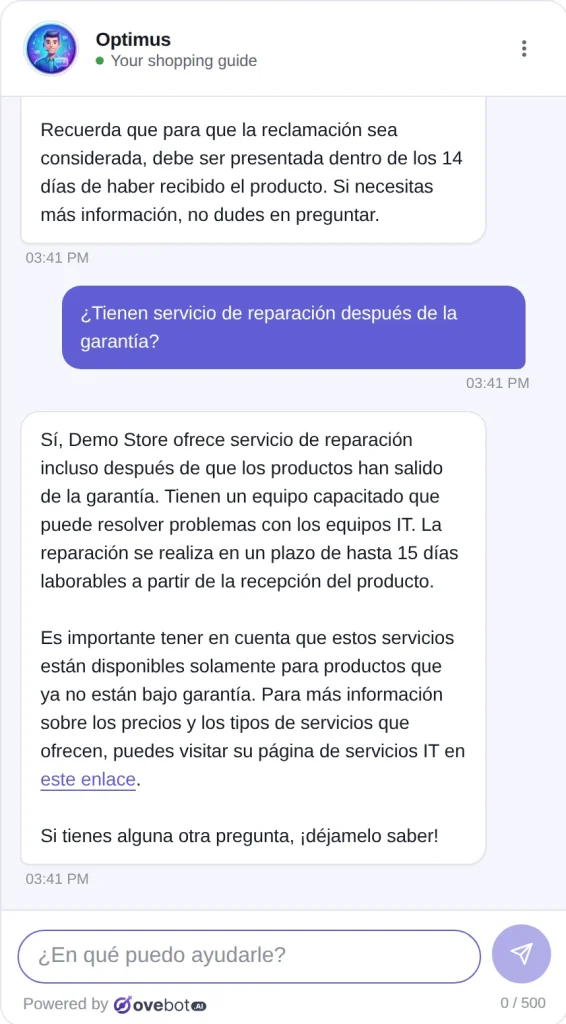
Shoppers also switch languages mid-chat. Here the chat started in English, and the second question came in Spanish.
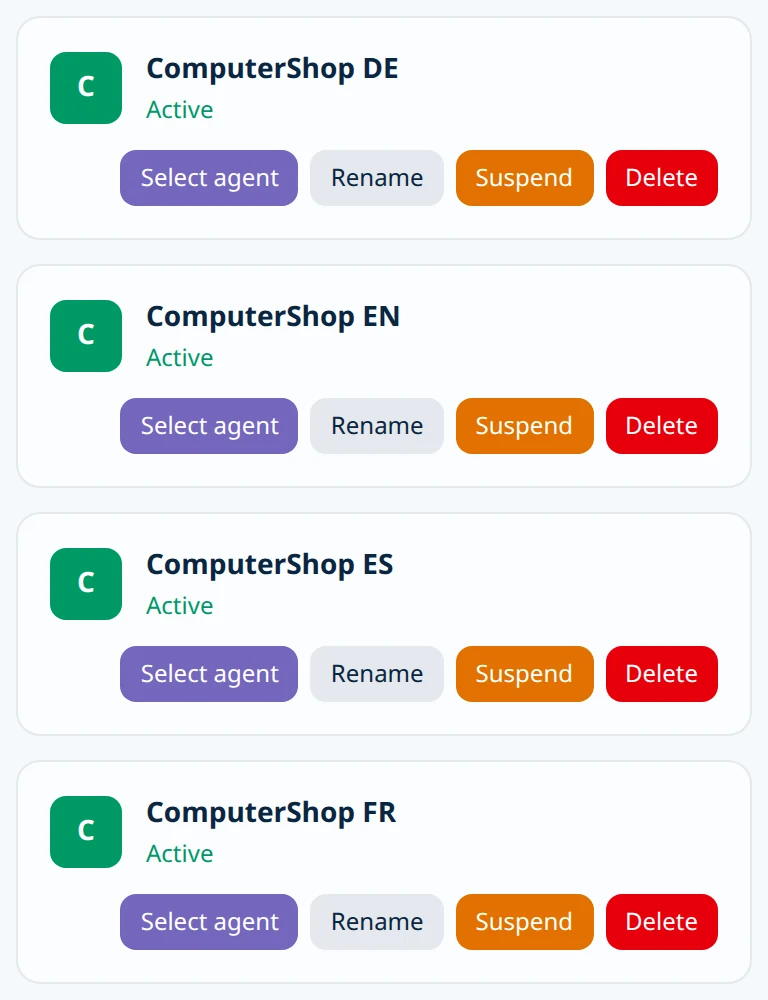
If you run one storefront per country or language, one account holds several sites or brands. Each has its own catalog, knowledge base and statistics.
For hard cases, the agent offers a person during your working hours, and your team sees the full conversation. Outside those hours, it shows your contact details.
Why we recommend Ovebot for cross-border stores
For a small store that needs multilingual customer support without a team in every language, we recommend Ovebot. Language detection, mid-chat switching, answers from your own content and human handoff are built in, as the features page shows.
Setup takes about 5 minutes with an official plugin for WordPress/WooCommerce, OpenCart, PrestaShop or Magento, or a one-line snippet on any other site. The 14-day free trial needs no card and gives you enough time to run the five test questions in each of your languages. Conversations are stored in EU data centers, as the GDPR page explains.
Frequently Asked Questions
No. EU law has no general rule that customer service must be in the shopper’s language. Member states can set language requirements for contract information, so check the national rules for each country you target. The 14-day right to cancel an online purchase applies across the EU, whatever language you answer in. This is not legal advice.
Start with the languages already in your orders and inbox. Give full human support to the languages your team speaks well. Cover languages with regular orders through AI chat plus a human reply in English or your own language. For the rest, offer chat only and say so on your contact page.
For routine questions, yes. An AI chatbot can answer questions about delivery, returns, warranty and payment from your policies in the shopper’s language. Keep a person for complaints and disputes. Test every language with the same questions, and have a native speaker review smaller languages. Our guide to why AI chatbots give wrong answers explains what to check.
Bottom line: tiers, clear policies and a person in reserve
Multilingual customer support for a small store is a matter of priorities, not headcount. Rank your languages, write the policies once, let the chatbot answer in the shopper’s language and keep a person for complaints and returns. Then repeat the five-question test whenever you add a market.
Sources
- European Commission, Key consumer data: Consumer Conditions Survey, 2025
- European Commission, Special Eurobarometer 540: Europeans and their languages, 2024
- European Commission, Flash Eurobarometer 313: User language preferences online, press release, 2011
- CSA Research, Can’t Read, Won’t Buy – B2C, press release, 2020
- Eurostat, Obstacles for web sales (isoc_ec_wsobsn2), 2021 data
- Eurostat, E-commerce statistics for individuals, data extracted February 2026
- European Union, Languages, accessed 2026
- Your Europe, Guarantees and returns, accessed 2026
- Your Europe, Pricing and payments, accessed 2026
- European Commission, Geo-blocking, accessed 2026
- Google Search Central, Managing multi-regional and multilingual sites, accessed 2026
- Robinson, Ogayo, Mortensen and Neubig, machine translation study across 204 languages, WMT 2023
This article was written with the help of artificial intelligence and reviewed by a human editor.